
Pervious concrete is the only pavement that treats stormwater where it lands instead of sending it somewhere else. In a city that has spent two decades rebuilding its stormwater strategy around exactly that idea, it should be everywhere.
It is not. And the reasons it is not are worth understanding before you specify it, because the failures are expensive and the successes are genuinely good.
What pervious concrete is
Pervious concrete is a deliberately gap-graded mix — coarse aggregate, cement paste, very little to no fine aggregate. The result is 15 to 25 percent interconnected void space that water passes straight through into a stone reservoir below.
Rain hits the surface and disappears. It does not sheet across the parking lot to a catch basin. It does not carry oil and sediment to the storm main. It infiltrates.
That is the whole value proposition, and it is why the City of Calgary lists permeable pavement among its Low Impact Development tools with a dedicated design guideline module behind it.
Where it works in Calgary — and where it does not
This is the section most articles skip, and it is the one that decides whether your project succeeds.
Good candidates
- Overflow and low-traffic parking stalls. Light loading, high surface area, real stormwater credit.
- Residential driveways and rear lanes where infiltration is being used to reduce a site’s runoff coefficient.
- Pathways, plazas and courtyards.
- Sites pursuing LID credit or LEED stormwater points, where the alternative is buying underground storage volume.
Poor candidates
- Heavy truck routes and loading areas. Pervious concrete has lower compressive strength than conventional pavement by design. Repeated heavy axle loading breaks it down.
- Sites with clay subgrade and no drainage path. If the water goes through the slab and then has nowhere to go, you have built a reservoir that freezes. Calgary has a great deal of clay.
- Areas that get sanded heavily in winter. Sand is what kills pervious concrete — see below.
- Slopes above a few percent without terraced check dams, because the water runs across the surface rather than through it.
The single most important qualifier is the subgrade. A geotechnical assessment of infiltration rate is not optional. If the native soil will not accept water at a usable rate, the design needs an underdrain — which changes the cost case entirely.
The freeze–thaw question everybody asks
The standard objection to pervious concrete in a cold climate is that water in the voids will freeze and destroy it.
The reality is more specific than that. A pervious system fails in freeze–thaw when the void structure is saturated at the moment of freezing. A properly designed system drains — the stone reservoir below sits above the water table, the water leaves, and there is nothing in the voids to expand.
What that means in practice:
- Reservoir depth and drainage design matter more than the mix.
- The system must be designed to fully drain between events.
- Where the water table or an impermeable layer is high, an underdrain is required, not optional.
Northern climates including Alberta have installations performing well over long service lives. They are the ones where the drainage was designed properly. The failures are almost always drainage failures wearing a freeze–thaw costume.
Maintenance: the part that decides the lifespan
Pervious concrete does not fail from wear. It fails from clogging, and in Calgary the clogging agent is winter sand.
The voids fill with sand, silt and organic debris. Infiltration rate drops. Eventually the surface behaves like conventional pavement and the entire reason you paid the premium is gone.
Maintenance is straightforward but non-negotiable:
- Vacuum sweeping two to four times per year, more where sand is applied heavily.
- No sand for winter traction. This is the hard constraint. If the site will be sanded, do not specify pervious.
- Keep landscaping sediment off it — this is the second most common clogging source, from adjacent soil and mulch beds washing across the surface.
- Do not seal it. Ever. Sealing a pervious surface is the same as replacing it.
Write the maintenance requirement into the operations plan before the pour, not after. A pervious lot handed to a property manager who does not know what it is will be sanded in November and clogged by March.
What it costs, honestly
Pervious concrete costs more per square metre than conventional concrete pavement. The mix is specialised, the placement is unforgiving, and the sub-base is thicker.
The cost case is not made at the pavement line. It is made at the stormwater infrastructure line: reduced or eliminated retention pond area, smaller storm connections, fewer catch basins, and developable land recovered from stormwater management.
On a site where land is expensive and stormwater volume is the constraint, that trade is often strongly favourable. On a site with cheap land and an easy storm connection, it usually is not.
If the project is chasing sustainability credit as well, our post on LEED v5 embodied carbon decisions covers how pavement choices interact with the newer credit structure, and our overview of Calgary’s green concrete codes covers the regulatory side.
Placement: why the crew matters more than the mix
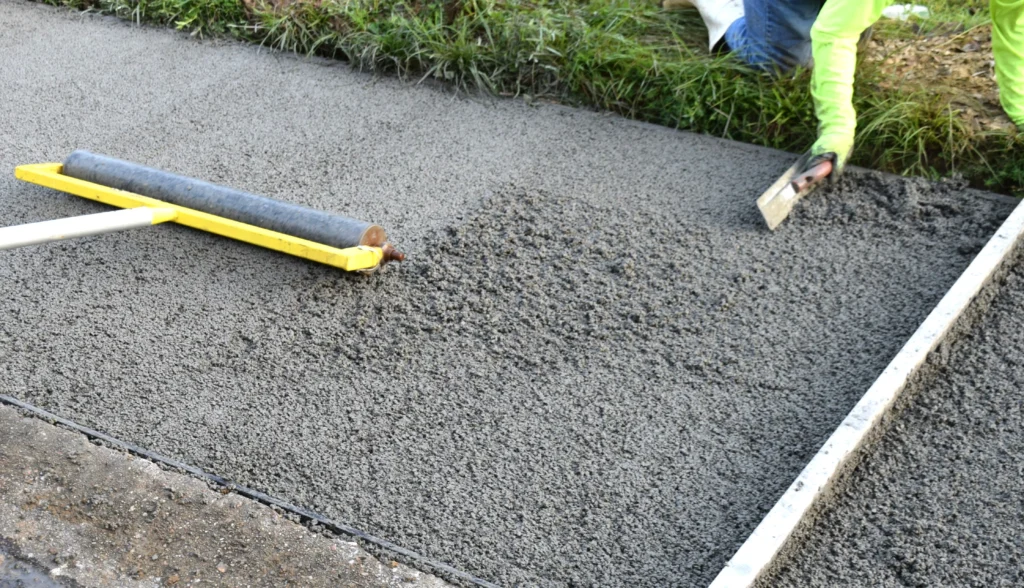
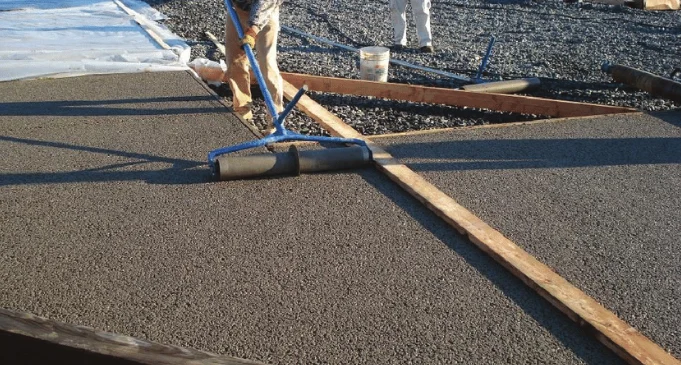
Pervious concrete is placed and finished nothing like conventional concrete, and a crew that has not done it before will damage it in the first hour.
- Very short working time. The low paste content means it dries fast. Placement has to be continuous.
- No troweling. Any surface working closes the voids. It is struck off and roller-compacted, not finished.
- Immediate covering and a long moist cure. Typically seven days under plastic. Skipping this is the most common cause of surface ravelling.
- No conventional vibration.
Hire a crew that has placed it before, and do a test panel. This is the one concrete product where the placement contractor’s experience is worth more than the mix design.
Our guide to sustainable concrete mixes in Alberta covers the other lower-impact options if pervious turns out not to suit the site.
FAQ
Does pervious concrete work in Calgary’s climate? Yes, where the system is designed to drain. Freeze–thaw damage occurs when the void structure is saturated at freezing. A correctly sized stone reservoir above the water table, with an underdrain where the subgrade will not infiltrate, addresses this. Drainage design matters more than the mix.
Is pervious concrete approved by the City of Calgary? The City includes permeable pavement in its Low Impact Development toolkit and publishes design guidance for it. Approval for a specific site depends on the application, the subgrade and the drainage design — confirm requirements with the City for your project.
How much maintenance does pervious concrete need? Vacuum sweeping two to four times per year at minimum, and no winter sanding. Clogging from sand and sediment is the primary failure mode; it is not a low-maintenance surface.
Can you use pervious concrete for a driveway? Yes, for passenger vehicle loading with suitable subgrade drainage. It is not appropriate for repeated heavy truck traffic.
Why can’t you put sand on pervious concrete in winter? Sand fills the interconnected voids and destroys the infiltration rate. Once clogged, the surface has to be vacuum-restored, and heavy clogging may be permanent.
Is pervious concrete more expensive than regular concrete? Per square metre, yes. The cost case comes from reduced stormwater infrastructure — smaller ponds, fewer catch basins, recovered developable land. It is a site-level calculation, not a pavement-level one.
Do you supply pervious concrete mix in Calgary? Yes. Omega Ready Mix batches pervious concrete for Calgary and area projects. Because the mix has a very short working window, we recommend discussing placement rate and crew experience before scheduling.
Planning Pervious Concrete for a Calgary Project?
Don’t choose pervious concrete based on the pavement cost alone. The subgrade, infiltration rate, drainage design, winter maintenance plan and placement conditions all determine whether the system will perform long-term.
Omega Ready Mix can help you evaluate the concrete side of the equation before your design is finalized. Talk to our team about your project requirements, placement conditions and pervious concrete mix needs so you can make an informed decision before construction begins.
Talk to Omega Ready Mix about your pervious concrete project
Sources
- City of Calgary, Permeable pavement — https://www.calgary.ca/water/stormwater/permeable-pavement.html
- City of Calgary, Design Guidelines for Low Impact Development, Module Six: Permeable Pavement — https://www.calgary.ca/content/dam/www/uep/water/documents/water-documents/development-approvals-documents/2019/module-six-permeable-pavement.pdf
- City of Calgary, Low Impact Development — https://www.calgary.ca/water/stormwater/low-impact-development.html
- Alberta Low Impact Development Partnership, permeable pavements — https://alidp.org/events-and-education/the-lid-toolbox/tools-for-achieving-lower-impact/permeable-pavements