
Alberta has led Canada in interprovincial migration for three straight years, gaining about 6,187 people from other provinces in a single quarter (Q2 2025), and a big part of the draw is land. Alberta homes run roughly 50 percent less than comparable BC properties, so a BC owner can sell, buy acreage near Calgary, and finally build the shop. That shop starts with the slab, typically a 150 mm (6-inch) reinforced slab on a compacted granular base, often with a thickened edge taken below the 1.2-metre frost line, sized to the building (a 30-by-40 shop floor is roughly 22 cubic yards at 6 inches, more with a thickened perimeter).
An acreage shop pour is exactly where on-site (volumetric) mixing fits: the site is usually 45 to 60-plus minutes from any batch plant, far enough that a drum-mix truck burns much of the CSA 2-hour discharge clock just getting there, so a mixer that batches fresh on arrival, to the correct Calgary sulphate-resistant spec, keeps a big rural slab inside the standard.
This article is the relocation story and the acreage-shop-slab fit. For the full yardage tables, see the shop-slab yardage article rather than re-reading them here. For the drive-time and discharge-clock detail, see the remote-pour article. We cross-link both below.
Why are so many people moving from BC to Alberta?
Because the math finally works, and the data backs it up.
Statistics Canada figures, reported through CBC, show Alberta gained 6,187 people via interprovincial migration in Q2 2025, marking 12 straight quarters, three full years, leading the country. Most of those migrants came from Ontario, Saskatchewan, and British Columbia. In Q3 2025, Alberta’s net interprovincial gain was 5,652, with British Columbia contributing 1,504.
(Source: Statistics Canada Q2 and Q3 2025 population estimates, reported by CBC; StatCan interprovincial migrants table. Point-in-time; re-verify the latest quarter.)
The engine underneath the numbers is price. Market reporting puts Alberta home prices nearly 50 percent below British Columbia’s, with an average Calgary home around $615,000 against roughly $1.2 million in Vancouver, and relocating households cutting their mortgage by 20 to 40 percent.
(Sources: Merge Mortgage; calgaryhomes.ca; point-in-time market context, validate current figures.)
For a lot of these owners the move isn’t just a cheaper house. It’s the equity to buy acreage and build the shop they’ve wanted their whole working life. And the shop starts with a slab.
Where do shop-builders land around Calgary?
In a recognizable arc of acreage communities, and naming them matters because the relocation pages never do.
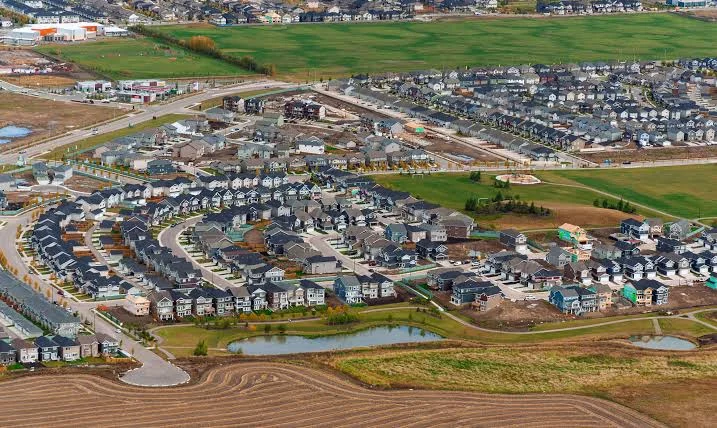
The acreage corridor around Calgary runs through Bearspaw, Springbank, Priddis, De Winton, Bragg Creek, the Foothills MD, and Rocky View County. These are the places a BC equity migrant buys into when they want a few acres and room for a 30-by-40 or 40-by-60 shop. A quick local heads-up: parts of Springbank can have Bearpaw bedrock near footing depth, and Priddis carries quartzite gravel, so the variable soils across the corridor are a reason to get a geotechnical look before you pour a big slab with a thickened edge. (Acreage corridor and soils per the Calgary concrete knowledge base.)
How thick should an acreage shop slab be?
Thicker than a house garage, because of what rolls across it.
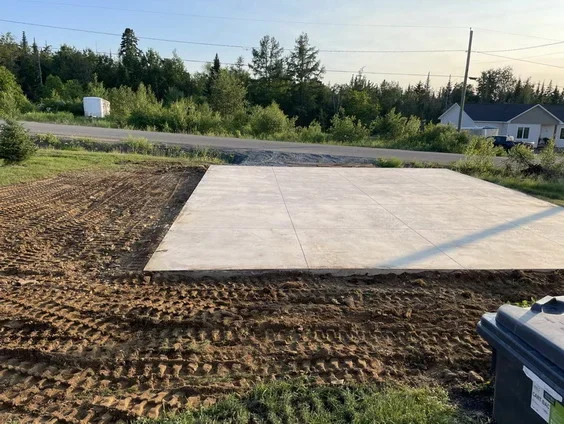
A shop floor that will carry trucks, a hoist, a tractor, or a loaded trailer wants 150 mm (6 inches), reinforced, on a compacted granular base. That mirrors the garage-pad guidance: 100 mm is fine for cars, 150 mm for trucks and equipment. The reinforcement is commonly #3 rebar at 16 to 18 inches on centre, with a doubled mat over any thickened edge. (Corroborated by Dutch Builders post-frame guidance.)
The detail an acreage shop needs that a city garage often doesn’t is the thickened edge below frost. The slab’s perimeter (or a thickened edge under load-bearing posts) should bear below the 1.2-metre frost line, or use frost-protection detailing, so the edge doesn’t heave through Calgary’s freeze-thaw winters. That’s the same frost rule that governs a foundation. National Building Code (Alberta Edition) Part 9 puts footings at least 1.2 metres below grade for exactly this reason.
What mix? It depends on the shop. A heated interior floor that never sees road salt can be F-2 (interior, no de-icing), which is the one case where air entrainment isn’t required. But most acreage shops carry equipment and vehicle traffic, with chloride slush tracked in at the door line, so they’re C-2: air-entrained, with a 0.45 water-to-cementing ratio, and Type HS or HSb cement for the sulphate-bearing acreage soil. Remote never means a wrong mix. Volumetric concrete meets the same ASTM C685 and CSA A23.1 standards as plant concrete; the strength article covers that in full.
How much concrete for a 30-by-40 shop slab?
Roughly 22 cubic yards at 6 inches, and more once you add a thickened perimeter.
A 30-by-40 slab at 6 inches works out to about 22 cubic yards. With an 18-by-12-inch thickened edge tapered to a 6-inch floor, the order rises to roughly 27 to 28 cubic yards.
(Sources: howmuchconcrete.io 30×40 slab; Dutch Builders.)
Those are headline figures. For the full 30-by-40 and 40-by-60 yardage tables, including different thicknesses and edge details, see the shop-slab yardage article rather than re-running them here.
Why is on-site mixing better for a big rural slab?
Two reasons, and both are sharper on an acreage than they are in the city.
The drive-time clock. A Calgary-to-acreage haul of 45 to 60-plus minutes eats much of the CSA A23.1 2-hour (120-minute) discharge clock before the chute even opens. (The 120-minute clause per Bernie Roseke, P.Eng..) A drum truck batches at the plant, so the concrete is aging the whole way out. A volumetric mixer batches fresh on arrival, so the distance doesn’t touch the mix, and the clock starts when you start pouring. Plants are also plant-fixed and frequently won’t drive that far for one pour. For the full clock physics, see the remote-pour article.
The single continuous pour. A shop slab is a large, single, continuous pour, and the thing you don’t want in the middle of it is a cold joint where one truck ran out before the next arrived. An on-site mixer produces continuously, from a yard up to 400-plus cubic yards a day as materials are replenished, without a truck-to-truck handoff gap. (Cemen Tech describes “1 to 400+ yards per day … as long as materials are replenished,” cementech.com.) For what a cold joint is and why a continuous pour matters, see the how-much-concrete article.
Put plainly: for an acreage owner who has already heard “we won’t drive out there” from a plant, on-site mixing isn’t a marginal preference. It’s the answer to whether the slab gets poured to spec at all.
The owner’s side of it
There’s a feeling under this that the spec sheets miss. For a lot of these builders the shop is the thing they’ve wanted for decades, and the worry isn’t the concrete itself, it’s whether a truck will even make it out to the property in time and still be good when it arrives. Finding out there’s a truck that mixes fresh right on the pad tends to be the answer they didn’t know existed. That relief is real, and it’s worth naming, because the relocation pages talk about mortgages and the cost pages talk about yardage, and nobody connects the dream shop to how the slab actually gets there.
FAQ
Why are so many people moving from BC to Alberta? Affordability. Alberta has led Canada in interprovincial migration for three straight years, and homes run roughly 50 percent less than in BC. Validate current figures.
How thick should an acreage shop slab be? Typically 150 mm (6 inches), reinforced, on a compacted granular base, often with a thickened edge taken below the 1.2-metre frost line for equipment and trucks.
How much concrete for a 30-by-40 shop slab? Roughly 22 cubic yards at 6 inches, and more with a thickened perimeter edge. See the shop-slab yardage article for the full tables.
Can I get concrete delivered to an acreage shop site far from a plant? Yes. A volumetric truck mixes on arrival, so a 45-to-60-minute drive doesn’t degrade the mix. The discharge clock starts when you start pouring.
Will an acreage shop slab crack in Calgary’s climate? Not if it’s built to spec: an air-entrained, sulphate-resistant Type HS or HSb mix, a thickened edge below frost, proper joints, and proper curing.
Why is on-site mixing better for a big rural slab? It batches fresh and continuously on site, to the correct Calgary spec, with no half-aged long-haul load and no truck-to-truck gap on a single continuous pour.
What soil issues should I check for on Calgary acreage? Variable soils across the corridor, including Bearpaw bedrock near grade in parts of Springbank and quartzite gravel near Priddis, so a geotechnical look is worth it before a big slab.
Turn Your Alberta Acreage Into the Shop You’ve Always Wanted
Moving to Alberta is about more than buying a larger property—it’s about finally having the space to build the workshop, equipment storage, or hobby shop you’ve planned for years. Calgary Concrete Master supplies fresh on-site volumetric concrete for acreage shop slabs throughout the Calgary region, delivering the exact volume you need with the correct CSA A23.1 mix design, even on remote rural properties.
Planning an acreage shop near Calgary? Contact Omega Ready Mix today for a personalized concrete estimate and expert guidance for your slab.