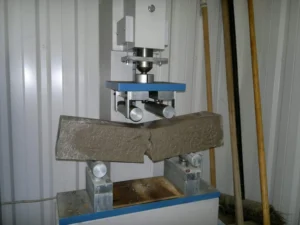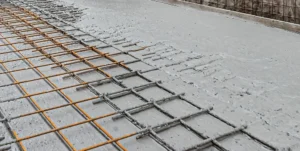

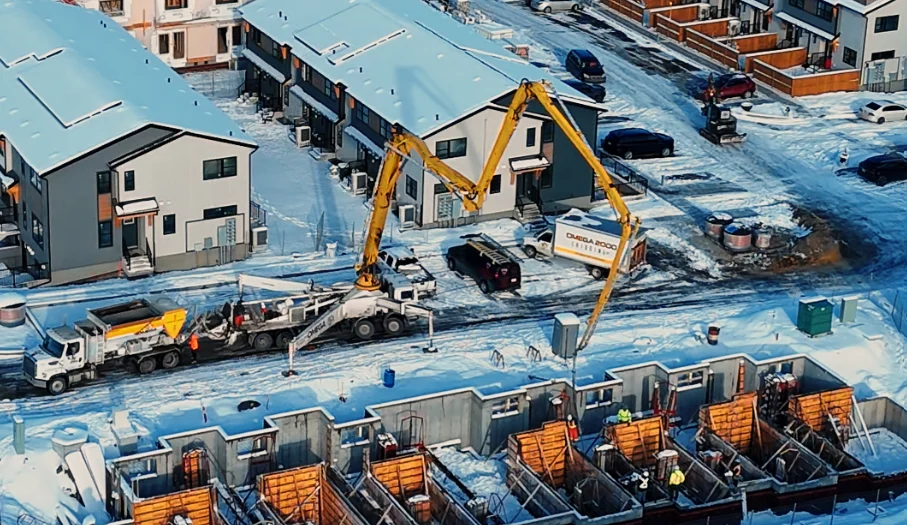
A footing pour in Springbank Hill on October 4, 2026, at 8 a.m. Air temperature is 2°C. Crew lead reaches for the printed ACI 306R cheat sheet in the truck. The standard reads “above 40°F” — that’s 4.4°C. The crew is already an hour past CSA’s 5°C trigger and didn’t know it. The blanket goes on cold concrete.
Calgary’s cold-weather concrete season starts earlier than most crews assume. By the second week of September, the overnight temperature drops below the CSA A23.1:24 5°C trigger across most of the city. By October 1, a daytime high in the low single digits puts the entire pour under cold-weather protocols. Crews who default to ACI 306R US translations import rules built for a milder climate and a different code framework. The CSA-anchored rules below are written for Calgary and read clean when cited correctly — these are the 7 a pour crew should be able to recite from memory by the third week of September.
1. The 5°C trigger that starts the protocol clock
A residential foundation crew in Mahogany on September 21, 2026. Daytime high 12°C, overnight low 3°C. The crew lead sees the daytime number and assumes it’s still summer-protocol. The supplier dispatcher pulls the historical low and refuses to dispatch without cold-weather mix documentation.
CSA A23.1:24 §7.6 defines cold-weather concrete operations as conditions when, for more than three consecutive days, the air temperature is below 5°C — or stays below 10°C for more than half of any 24-hour period. Once that trigger is met, the cold-weather provisions of §7.6 apply in full. There is no calendar override; the trigger is the trigger.
Calgary’s 30-year historical data puts the first 5°C trigger condition in early-to-mid September across most of the city. The protocol clock starts when the trigger condition is met, not when the calendar flips to October. A crew that pours on September 18 thinking “summer mix is still fine” because the daytime high was 14°C has already missed the trigger if the prior three nights ran 4°C, 3°C, and 4°C.
The 5°C trigger is the line between summer-protocol concrete and cold-weather concrete. Crossing it without adjusting the mix design, the placing temperature, the cure protection, and the documentation is the most common Calgary cold-weather failure mode. The supplier’s dispatcher checking the historical low before releasing the truck is the second-best defence after the crew lead checking it first.
The trigger sets the calendar. The next rule sets the temperature.
2. The 10°C placing temperature that volumetric can hit without a plant
A driveway pour in Discovery Ridge on October 18, 2026. Daytime high 4°C. The drum-mix delivery from a plant 35 km away arrives with the concrete at 9°C — under the placing minimum. The supplier sends a second truck, this time with hot water tempering. Ninety minutes lost. The pour starts at 11 a.m. instead of 7:30 a.m. The crew loses the morning placement window.
CSA A23.1:24 §7.6 specifies minimum concrete temperature at the point of placement based on member thickness. For typical residential and light-commercial sections, the minimum is 10°C at discharge. The supplier is responsible for delivering concrete that meets this minimum; the placing crew is responsible for verifying it on every truck.
Volumetric mixers can heat the mixing water on-site, which decouples the placing temperature from the plant-to-site transit-cooling problem. On a Calgary cold-weather pour 30–50 km from the nearest batching plant, the on-site heated-water approach removes a structural failure mode from the pour-day timeline. Omega Ready Mix’s volumetric units meet the same ASTM C685/C685M-25a and CSA A23.1 standards as plant ready-mix, and the on-site batching window means water temperature is tuned to the truck-side air temperature, not the morning forecast read at the plant.
A pour that starts below 10°C never reaches design strength on the original cure curve. The 7-day and 28-day cylinders will document the deficit. The structural review board will document the deficit. The crew that placed the concrete will own the deficit. The 10°C minimum is not a recommendation in CSA — it is the placing-temperature floor.
Hitting placing temperature is one half of cold-weather discipline. The other half is keeping the placed concrete warm enough to develop strength.
Temperature is only one field that matters on a concrete delivery ticket. Homeowners and developers should also understand the eight batch-ticket fields that determine whether the delivered mix actually matches the specification. Read 8 concrete quote line items Calgary homeowners misread (and what the batch ticket actually means in 2026).
3. The 10°C/7-day cure that almost no Calgary crew runs all the way out
An acreage shop slab in Springbank on October 28, 2026. Daytime high 7°C, overnight low -2°C. The crew places at 11°C with hot water. Insulated blankets go on at 4 p.m. The blankets come off at 8 a.m. the next morning so the crew can move off-site. They tell the owner “the cure is on.” The slab is fully exposed to the second day’s overnight drop to -6°C with a measured strength under 5 MPa.
CSA A23.1:24 §7.6.5 requires that concrete be maintained at a temperature of at least 10°C for a minimum of 7 days — or until the specified strength is achieved, whichever comes first — for general cold-weather pours. The protection cannot be pulled the morning after the pour. The 7-day floor is a CSA requirement, not a supplier suggestion.
Maturity-method monitoring — data loggers embedded in the slab that track temperature-time history against a calibrated strength-maturity curve — is the only defensible way to verify the cure is actually meeting the temperature-time requirement under variable Calgary conditions. Visual inspection of the blankets is not verification. A blanket can be in place and the concrete underneath can be at 4°C; the cure clock stops when the temperature drops below 10°C, not when the blanket comes off.
The 7-day cure is the single most-skipped step in Calgary cold-weather residential and light-commercial pours. The skip rarely produces an immediate visible failure. It produces a slab that’s at 70–80% of design strength entering its first freeze-thaw winter, which is the slab that spalls in Year 1. The structural cylinder report and the field-cured cylinder report will be the document that explains the spall — both should be on file for every cold-weather pour, every time.
Spec writers can lock this in by writing “10°C/7-day cure with maturity-method verification” into the cold-weather addendum, not “as per CSA.” General references get interpreted; specific references get followed.
The 7-day cure ties the protection to strength. The next rule defines the strength below which freezing concrete is permanently damaged.
4. The 7 MPa early-frost threshold that ACI/US sources sometimes get wrong
A site superintendent in Aspen Woods on November 2, 2026, on a slab placed three days earlier. Overnight low -8°C with no protection. The super hands the cylinder report to the structural reviewer. The 3-day strength is 6.2 MPa. The reviewer pulls CSA, then pulls the US ACI 306R that the super is quoting. The CSA threshold is 7 MPa; the US reference the super used cited a different number for a different protection condition. The super was reading the wrong row of the wrong standard.
CSA A23.1:24 §7.6.4 requires that concrete reach a compressive strength of 7 MPa before being exposed to one cycle of freezing. Below 7 MPa, freezing causes permanent ice-lens damage to the cement matrix — micro-cracking that no subsequent cure can repair. The number is 7 MPa, not 8 MPa, not 3.5 MPa. It is the bright line.
The 7 MPa figure is specific to CSA and is the correct threshold for Alberta pours. Some US-sourced material cites different protection thresholds for different conditions; these are NOT the CSA Canadian threshold and should not be cited in Calgary documentation. Spec writers who lift cold-weather language from US guidance documents and paste it into Alberta specs are quietly introducing a citation error that gets caught at the structural review stage — or worse, never gets caught at all and a 6 MPa slab gets signed off as protected.
A pour crew that protects to 8 MPa “to be safe” is fine. A pour crew that protects to 5 MPa thinking 5 is the threshold has a permanently weakened slab. The 7 MPa rule is also why early-strength cylinders matter — without a 3-day or 5-day field-cured cylinder, the crew has no way to verify the slab has crossed the threshold before pulling protection.
For Calgary projects, the cold-weather spec language should read: “Concrete shall reach a minimum compressive strength of 7 MPa, verified by field-cured cylinder or maturity-method, before exposure to any cycle of freezing temperatures, per CSA A23.1:24 §7.6.4.” That sentence belongs in every cold-weather addendum.
The 7 MPa rule defines the floor. The next rule defines the input that determines how fast the floor is reached.
5. The hot-water tempering volumetric can do that drum-mix can’t (mid-load)
A late-October pour in Cranston, 2026. The first truck arrives, the crew places, the cure goes on. Mid-afternoon the air temperature drops faster than forecast. The second truck — drum-mix from a plant 28 km away — is already loaded with un-tempered water and rolling. By the time it arrives the concrete is at 8°C. The crew rejects it. $1,200 of concrete and 90 minutes lost.
CSA A23.1:24 §7.6.2 permits hot-water tempering up to specified maximum cement and water temperatures (typically 60–65°C for mixing water at the plant or batch point) to deliver concrete at the required placing temperature. The mechanism is straightforward: hotter mixing water raises the concrete temperature at discharge, offsetting transit cooling and ambient cooling at the point of placement.
The difference between a drum-mix and a volumetric delivery is when the tempering decision gets made. Drum-mix water is tempered at the plant — the morning batch, the morning forecast, the morning’s read on the day’s weather. Volumetric mixers batch on-site, which means the water can be tempered to the actual mid-afternoon weather instead of the morning forecast. The plant-to-site transit time on Calgary’s outer-ring projects is often 40–60 minutes; cold-weather mix temperature drops measurably across that window. On-site water tempering compresses the temperature-decay timeline to single-digit minutes between batching and discharge.
Volumetric mixers also reset the CSA 2-hour discharge clock differently. With drum-mix, the clock starts at plant batching and includes transit. With volumetric, the clock starts at on-site batching and the transit-cooling problem doesn’t exist — the water that goes in the mix was just measured into the mixer at the site-board temperature the dispatcher confirmed two minutes earlier. Volumetric units operate to the same ASTM C685/C685M-25a and CSA A23.1 standards as plant ready-mix; the on-site batching is the wedge in cold weather, not a quality difference.
Cold-weather pours fail at the boundaries — first truck of the day, last truck of the day, the mid-afternoon weather shift. The supplier delivery model that can adjust at the boundary is the model that finishes the pour without a rejection.
Tempering is the mix-side adjustment. The next rule is the site-side adjustment.
6. The hoarding-and-heat requirement that’s not optional below -5°C ambient
A foundation wall pour in Bridlewood on November 5, 2026. Ambient -7°C with wind. The crew set blankets but no hoarding tarps. Wind chill on the exposed wall face drives the surface temperature to -15°C while the core is still curing at +10°C. The wall develops a thermal gradient that opens hairline cracks visible at form-strip.
CSA A23.1:24 §7.6.5 requires that, when ambient conditions warrant, supplemental heat and enclosure (hoarding) be provided to maintain the concrete and surrounding air at the cure temperature. Below approximately -5°C ambient, hoarding plus supplemental heat is typically required, not optional. Concrete Alberta’s Cold Weather Best Practices §4 reads the same way.
Hoarding adds 10–25% to cold-weather pour cost depending on form size, complexity, and whether the crew already owns the tarps and heaters. The cost is real. The failure cost — a structural wall pour with thermal cracks visible at form-strip — is 5–10× the hoarding cost on remediation alone, and that’s before the structural-review delay and the schedule hit downstream of it. The math is not close.
The wind-chill differential between exposed surface and protected core is the cold-weather failure mode that doesn’t show up in the ambient-temperature forecast. The forecast reads -7°C; the wind reads 35 km/h; the surface temperature reads -15°C. The crew that hoards “only when ambient is bad” routinely misses the surface-temperature pattern and ends up with cracks they can’t explain to the structural reviewer. The cracks were not random; they were the wind-chill-driven thermal gradient doing exactly what physics said it would do.
Hoarding decisions belong in the pour-day plan, not in the truck. The crew lead who confirms hoarding at 6 a.m. before the truck rolls has eliminated one variable. The crew lead who decides at 9:30 a.m. with the slab half-placed has already lost. Heat sources — propane, electric, or hydronic — need to be specified, vented, and monitored; an unvented propane heater inside a closed hoarding tarp is a CO hazard on top of being a temperature uncertainty.
Hoarding handles the site. The final rule handles the season.
7. The September 30 cutoff conversation every Calgary spec writer should have already
A developer in Inglewood on September 24, 2026, calls the supplier about an October 7 pour for a 4-plex foundation. The supplier asks: “Hot-water tempering, hoarding, supplemental heat, blanket protection, 10°C/7-day cure, 7 MPa minimum, and the maturity-method data logger?” The developer pauses. “Most of those.” The supplier offers two options: ship the pour with full cold-weather protocol at the cost premium, or move the pour to a March 2027 window when summer-protocol mix design works.
The “Sept 30 cutoff” is not a code rule — it’s the date by which CSA A23.1:24 §7.6 cold-weather provisions reliably apply across most Calgary projects. Suppliers and crews use the date as a planning anchor: pre-Sept 30 = summer protocol viable; post-Sept 30 = cold-weather protocol mandatory. Concrete Alberta’s Cold Weather Best Practices §2 references the historical-pattern application that puts the trigger condition reliably in place by late September.
Calgary’s 59–65 ideal pour days per year is the statistical reality the cutoff codifies. After Sept 30, every additional pour day costs the supplier 15–25% more to deliver — heated water, longer mix times, hoarding logistics, the maturity-method loggers — and costs the crew an additional 20–30% in productivity loss against summer pace. The cutoff conversation is the financial conversation.
Spec writers and developers who don’t have the cutoff conversation by mid-September discover the cost premium and protocol burden at the truck on pour day. By then the schedule is locked, the project is committed, and the price is whatever the supplier quotes for cold-weather delivery — which is the right price, but it’s a number the developer never planned for. The financial planning window is in the spec, not the parking lot. A line item that reads “cold-weather contingency: hot-water tempering, hoarding, blanket protection, maturity-method verification per CSA A23.1:24 §7.6 — applicable to all pours after September 30” makes the cost visible upstream.
The 7 rules above are the operator’s-language version of CSA A23.1:24 §7.6. They should be printable, postable, and citeable from memory by the third week of September every year. Validate dollar figures against current Calgary quotes — pricing here references industry-survey ranges, not Omega’s price list.
FAQ
Q1: What’s the legal cold-weather concrete trigger in Alberta? CSA A23.1:24 §7.6 defines cold-weather operations as conditions where, for more than three consecutive days, the average air temperature is below 5°C — or stays below 10°C for more than half of any 24-hour period. Once either condition is met, the full cold-weather provisions of §7.6 apply. The trigger condition usually appears in early-to-mid September in Calgary based on Environment Canada’s 30-year climate normals, not on October 1.
Q2: Why is the 7 MPa threshold cited by CSA when US sources cite different figures? CSA A23.1:24 §7.6.4 specifies 7 MPa as the compressive strength below which freezing causes permanent ice-lens damage to Canadian-spec concrete. US references (such as ACI 306R-16) cite different thresholds for different protection conditions. The CSA value is the Alberta authoritative reference and is the number that should appear in Calgary cold-weather spec language — not the US figure.
Q3: Can volumetric concrete really hit the 10°C placing minimum in cold weather? Yes. Volumetric mixers can heat the mixing water on-site to deliver concrete at the required placing temperature, regardless of ambient or transit conditions, within the supplier’s heated-water capacity. Volumetric units meet the same ASTM C685/C685M-25a and CSA A23.1 standards as plant ready-mix; the difference is that on-site batching means the water temperature is tuned to truck-side weather, not morning-forecast plant conditions. (See ACI 304.6R-09(R2019) for the volumetric-equipment guide.)
Q4: How long do the cold-weather protection requirements apply? Until the concrete reaches the specified strength (typically the design strength, or at minimum 7 MPa before first freeze), or for a minimum of 7 days at 10°C, whichever comes first per CSA A23.1:24 §7.6.5. Pulling the protection at 24 hours because the daytime forecast looks better is not compliant with §7.6.5. Maturity-method data loggers are the defensible way to verify the temperature-time requirement was met.
Q5: Is hoarding required by CSA, or is it just recommended? Required when ambient conditions warrant, per CSA A23.1:24 §7.6.5. Below approximately -5°C ambient, hoarding plus supplemental heat is typically required, not recommended. Concrete Alberta’s Cold Weather Best Practices §4 reads the same way. Hoarding decisions belong in the pour-day plan, with heat sources specified, vented, and monitored.
Q6: When does Calgary’s cold-weather concrete season actually start? The 5°C trigger condition is typically met in early-to-mid September based on 30-year historical data from Environment Canada’s Calgary climate normals (1991–2020). The “Oct 1” or “Sept 30” cutoff is the calendar anchor most Calgary suppliers and spec writers use to mark the transition from summer-protocol to mandatory cold-weather protocol. The trigger is the legal threshold; the cutoff is the planning anchor.
Sources
- CSA A23.1:24 / A23.2:24 — §7.6 Cold-weather concreting — https://www.csagroup.org
- Concrete Alberta — Cold Weather Best Practices — https://www.concretealberta.com
- ACI 306R-16 — Guide to Cold Weather Concreting — https://www.concrete.org
- ACI 304.6R-09(R2019) — Volumetric-Measuring and Continuous-Mixing Concrete Equipment — https://www.concrete.org
- Environment Canada — Calgary climate normals 1991–2020 — https://climate.weather.gc.ca
- ASTM C685/C685M-25a — Standard Specification for Concrete Made by Volumetric Batching and Continuous Mixing — https://www.astm.org
- City of Calgary — Standard Construction Specifications — https://www.calgary.ca/development/standards
- NBC(AE) 2023 — National Building Code Alberta Edition — https://www.alberta.ca
- CSA A23.3:24 — Design of concrete structures — https://www.csagroup.org
About Omega Ready Mix
Omega Ready Mix is Calgary’s volumetric ready-mix supplier (est. 2023), delivering on-site-batched concrete that meets the same ASTM C685/C685M-25a and CSA A23.1 standards as plant ready-mix, with cold-weather hot-water tempering at the truck rather than at the plant.