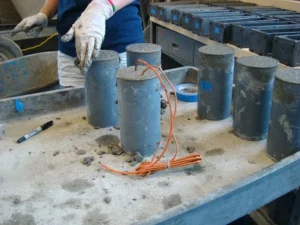

Yes — volumetric concrete meets the same ASTM C685 / CSA A23.1 standards as plant (ready-mix) concrete. It is not a different, weaker product; it is the same concrete mixed on site instead of at a plant. It is governed by its own dedicated standard, ASTM C685/C685M (current edition -25a), written by the same ASTM subcommittee that maintains the ready-mix standard. The hardened concrete is tested for strength by the same method — ASTM C39 cylinder breaks — against the same CSA A23.1:24 mix-design targets. In Alberta, the producing facility is independently certified under Concrete Alberta’s Mobile Mixer Facility Certification (P.Eng. inspection, re-audited every three years), and operators hold VMMB operator certification.
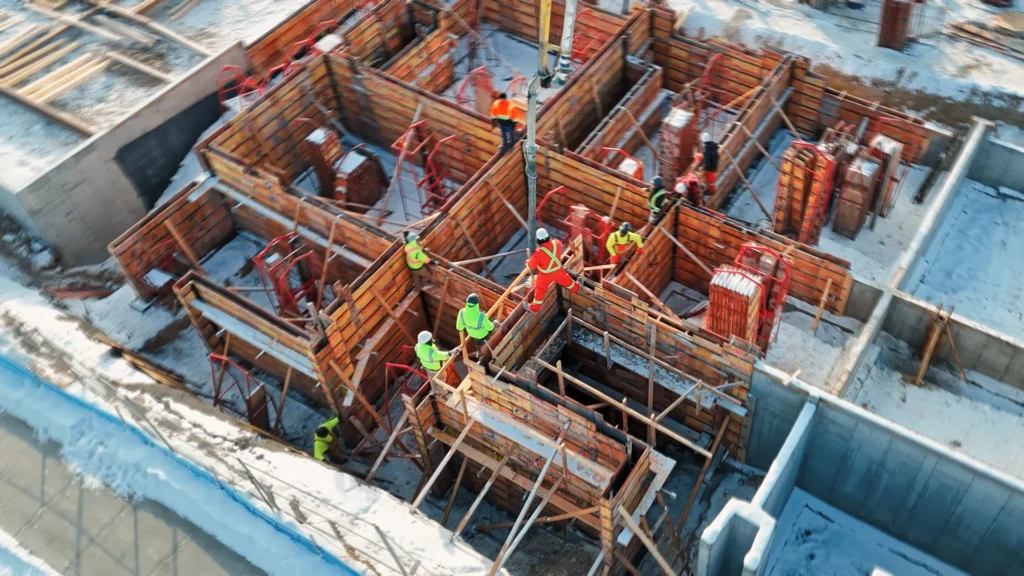
The honest, full answer
“Is it as strong?” is the single most common question we get about volumetric concrete — and the right way to answer it is with standards, not slogans.
The instinct behind the question is reasonable: a truck that mixes concrete at the curb looks different from a plant-batched drum truck, so people assume it must be a lesser product. It isn’t. Strength in concrete comes from the mix design — the proportions of cement, water, aggregate, and admixtures — not from the building the mixing happens in. A 32 MPa mix is a 32 MPa mix whether it’s combined in a stationary plant or metered out of a mobile mixer’s compartments.
What follows is the proof: the standard that governs volumetric, how it relates to the ready-mix standard, how the concrete is tested, and the certification stack that backs it in Alberta. We run Calgary’s only city-based volumetric fleet, so when a builder, superintendent, or homeowner asks “how is this legal?” or “how do we spec this?”, this is the documented answer.
What ASTM C685 actually is — in plain English
ASTM C685 / C685M is titled Standard Specification for Concrete Made by Volumetric Batching and Continuous Mixing. The current edition is C685/C685M-25a (with -24 also active). It is published by ASTM International and developed by Subcommittee C09.40 — the same group that maintains C94, the ready-mix-truck specification. C09.40 wrote C685 to be the structural twin of C94: where C94 governs concrete mixed centrally and delivered in a drum, C685 governs concrete metered from separate raw-material compartments and mixed continuously as it’s discharged. (See ASTM’s C685 listing.)
The scope is precise. C685 covers concrete “made from materials continuously batched by volume, mixed in a continuous mixer, and delivered to the purchaser in a freshly mixed and unhardened state.” It specifies batching accuracy and mixing-efficiency criteria. Cement, aggregates, water, supplementary cementing materials, air-entraining and chemical admixtures all have to meet the same ASTM source standards ready-mix is held to. Where the purchaser’s specification differs from the standard’s defaults, the purchaser’s specification governs.
What C685 does not cover — exactly like C94 — is placement, consolidation, finishing, or curing. The standard tells the operator what has to be true about the concrete at the moment of discharge.
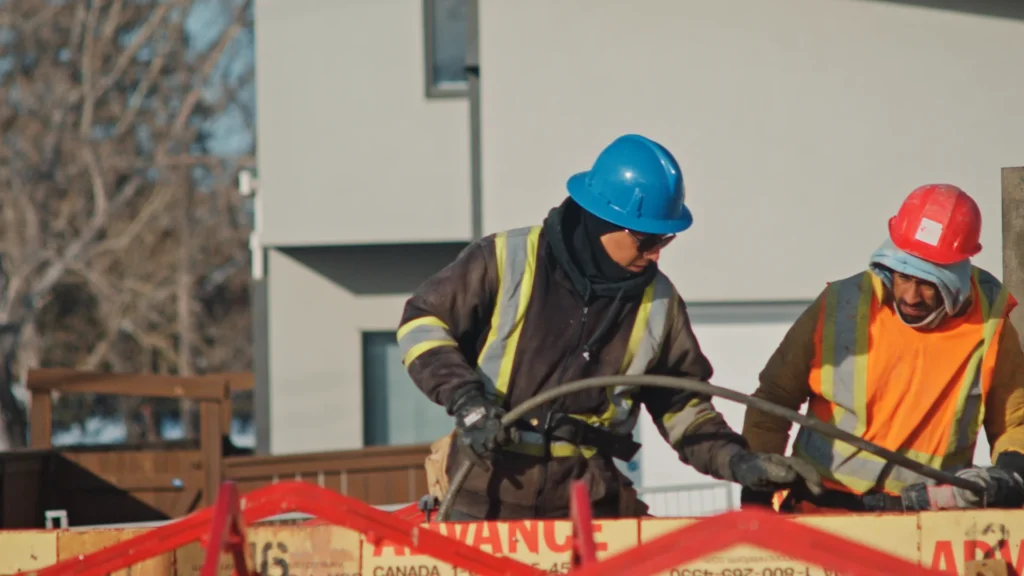
Tested the same way: ASTM C39, the same cylinder breaks
This is the part that settles the strength question. A volumetric pour’s concrete is verified with the same field and lab tests run on ready-mix loads:
- ASTM C39 / C39M — compressive strength of cylindrical specimens. The same cylinders, cured and crushed in the same press, reported in the same MPa. (What C39 is.)
- ASTM C138 — yield and unit weight.
- ASTM C143 — slump.
- ASTM C173 / C231 — air content.
- ASTM C1064 — concrete temperature.
When a Calgary engineer of record wants proof a volumetric foundation hit spec, they ask for the field cylinder reports — C39 breaks at 7, 28, and 56 days — against the CSA A23.1:24 target. Those breaks don’t care how the concrete was mixed. They measure the concrete. Same test, same target, same pass/fail line.
How C685 and CSA A23.1 work together for Calgary
Every cubic metre poured in Alberta — regardless of production method — has to meet CSA A23.1:24, Concrete Materials and Methods of Concrete Construction (14th edition, June 2024). That’s the umbrella standard governing mix design, exposure classes (the C-XL / F / N / S categories that drive Alberta foundation specs), durability, water-cement-ratio limits, and field testing.
ASTM C685 sits underneath that. It governs how a volumetric truck has to operate to deliver concrete that meets a CSA A23.1 mix design. The two aren’t competitors — and CSA recognizes the method explicitly: CSA A23.1:24 §5.2.2.8 is the clause that governs volumetric/mobile mixers, requiring compliance with that section and with ASTM C685/C685M (as stated on Concrete Alberta’s certification page).
So a Calgary volumetric pour is verified against three documents at once:
- The CSA A23.1:24 mix design — exposure class, strength, w/cm limit, air range, slump range.
- The ASTM C685 batching tolerances and calibration records — proof the truck metered within standard variance.
- The Concrete Alberta MMF certification audit — proof the facility and operator are independently certified.
The correct tender language is: “Concrete to CSA A23.1, [exposure class], mix design [code], delivered by volumetric mobile mixer to ASTM C685.” Mix design is CSA. Production method is ASTM C685. Certification is provincial.
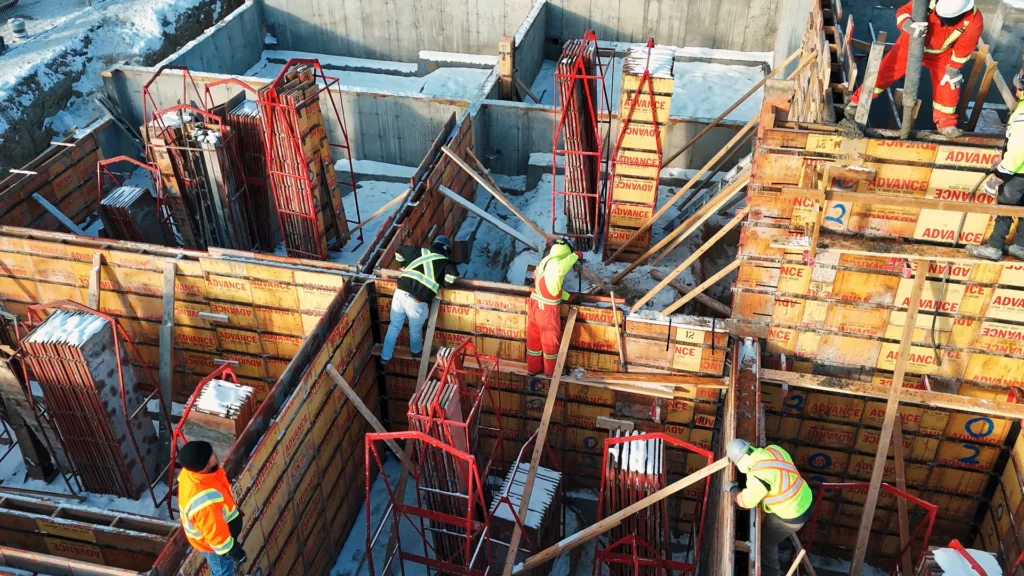
Don’t be misled by the UK “it isn’t accredited” framing
If you’ve already searched this question, you’ve probably read a British comparison saying “ready-mix is accredited under BS EN 206 / BS 8500; volumetric is not — so ready-mix is more consistent.” That framing is everywhere in foreign content, and for a Calgary buyer it’s actively misleading.
BS EN 206 and BS 8500 are a British accreditation regime. They do not govern a single pour in Alberta. Citing them to question volumetric here is like quoting UK building codes to challenge a Calgary foundation — wrong jurisdiction. In North America, volumetric is governed by a dedicated ASTM standard (C685) and, in Alberta, by a provincial facility certification with a P.Eng. audit. The British framing isn’t a knock on UK volumetric; it’s simply irrelevant to what your Calgary engineer and inspector actually check against.
The Alberta certification stack: why a volumetric pour is independently audited
ASTM C685 is the production standard. Two layered certification programs govern volumetric concrete in Calgary on top of it:
Concrete Alberta Mobile Mixer Facility (MMF) Certification — the provincial credential
To hold MMF certification, the producer must be a Concrete Alberta member in good standing; the facility must be inspected by a qualified Professional Engineer (P.Eng.) or Professional Technologist (P.Tech.); and every operator must complete the Auditor Qualification / Producer Orientation training. The certification confirms the facility “has the capability of producing quality concrete as per CSA A23.1 … and A23.2,” and is subject to a third-party-validated audit every three years. (Concrete Alberta MMF.)
VMMB / VMOC — the operator credential
VMMB is the Volumetric Mixer Manufacturers Bureau (founded in 1999 with the NRMCA). Its Volumetric Mixer Operator Certification (VMOC) is the operator-side credential: at least three months of on-the-job experience, a four-topic curriculum (Safety, Concrete Technology, Volumetric Operation & Maintenance, Customer & Company Relations), and a closed-book, 65-question exam requiring 70% overall and no less than 60% on any section. Certification runs a five-year term. (VMMB operator certification.)
On the engineering side, ASTM C685 is paired with ACI 304.6R (the ACI guide for volumetric/continuous-mixing equipment) and AASHTO M241 (the DOT/highways spec) — the three-standard quality stack the specialty trades already trust. (VMMB specifications.)
Written out, the stack is:
- ASTM C685-25a — the production specification
- CSA A23.1:24 (§5.2.2.8) — the mix-design and materials standard, with the volumetric clause
- VMMB VMOC — the operator credential, five-year term
- Concrete Alberta MMF — the facility credential, three-year re-audit, P.Eng./P.Tech. inspection
A volumetric fleet operating in Calgary that holds all four is operating to the published standard of the industry.
“The operator is the plant” — why the batch ticket is more granular
A ready-mix ticket documents the central mix at the moment it was batched at the plant. A volumetric ticket documents something more detailed, because the concrete is produced at your site in real time — the onboard computer logs the pour as it happens:
- Mix design called up on the truck’s control system (by mix code).
- Volume discharged, measured at the auger-output meter.
- Water-cement ratio as actually batched — every litre metered, cross-referenced to cement discharge.
- Admixture dosing — air entrainer, water reducer, retarder or accelerator, integral colour, fibres.
- Ambient conditions — temperature (and sometimes humidity), which matter for Calgary’s hot- and cold-weather provisions.
- Operator ID and unit ID — which certified operator ran which certified truck.
Engineers of record on Calgary residential projects routinely request the foundation-pour ticket alongside the field cylinder reports. On a volumetric pour, that ticket is a per-pour QC trail — and it’s a deliverable, handed over with the cylinder results.
A drum truck arrives with a load someone else made. On a volumetric truck, the operator is the plant — which is exactly why the VMOC operator certification exists, and why C685’s calibration regime tests the equipment (meters, cement-bin discharge, dosing pumps, mixer wear) as rigorously as it does.
Can volumetric batch the sulphate-resistant concrete Calgary needs?
Yes — and this is where the “is it real concrete” question gets a Calgary-specific answer. Most Calgary lots sit on S-2 sulphate soils (0.20%+ water-soluble sulphate), which call for Type HS / HSb sulphate-resistant cement under CSA A3001.
CSA A23.1:24 Table 2 sets a minimum of 32 MPa at 56 days for S-2 exposure (35 MPa is a common market premium), with 5–7% entrained air for our roughly 128 freeze-thaw cycles a year, and footings below the 1.2 m frost depth. Volumetric trucks routinely batch Type HS mixes to these durability targets — the dry materials and admixtures are simply proportioned to the spec, the same as any plant mix.
The advantage is freshness: the concrete is mixed on arrival rather than sitting in a drum activating cement on the drive.
FAQ
Is volumetric concrete as strong as plant (ready mix) concrete? Yes. It meets the same ASTM C685 / CSA A23.1:24 standards and is tested by the same method (ASTM C39 cylinder breaks) against the same mix-design targets. Strength comes from the mix design, not from where the concrete is mixed.
What standard governs volumetric concrete? ASTM C685 / C685M (current edition -25a), written by the same ASTM subcommittee (C09.40) that maintains the ready-mix standard C94. In Canada the mix itself is governed by CSA A23.1:24, including the volumetric clause §5.2.2.8.
Is volumetric concrete tested the same way? Yes — the same field and lab tests: ASTM C39 for compressive strength, plus C138 (yield/unit weight), C143 (slump), C173/C231 (air content), and C1064 (temperature).
Will volumetric concrete pass a Calgary building inspection? Yes. It’s governed by ASTM C685 and CSA A23.1:24 §5.2.2.8, the producing facility is certified under Concrete Alberta’s MMF program, and the per-pour batch ticket plus field cylinder reports give the engineer of record the documentation they ask for.
What is Concrete Alberta Mobile Mixer Facility Certification? A provincial credential confirming a volumetric facility can produce concrete to CSA A23.1 and A23.2. It requires Concrete Alberta membership, a P.Eng./P.Tech. inspection, operator training, and a third-party-validated audit every three years.
What is VMMB / VMOC operator certification? VMMB is the Volumetric Mixer Manufacturers Bureau; VMOC is its operator credential. The exam is closed-book, 65 questions, with a 70%-overall and 60%-per-section pass mark, valid for five years, and requires at least three months of on-the-job experience.
Can volumetric batch Type HS sulphate-resistant concrete for Calgary foundations? Yes. For Calgary’s S-2 sulphate soils, volumetric trucks routinely batch Type HS / HSb mixes to the CSA A23.1:24 Table 2 targets (minimum 32 MPa at 56 days for S-2; 5–7% air).
How do I spec volumetric concrete in a tender? Use: “Concrete to CSA A23.1, [exposure class], mix design [code], delivered by volumetric mobile mixer to ASTM C685; fleet to hold current Concrete Alberta Mobile Mixer Facility certification; operators to hold current VMMB VMOC; volumetric batch ticket required at delivery.”
Need concrete that meets Calgary engineering specs?
Get a volumetric concrete quote with ASTM C685 batching, CSA A23.1 mix designs, and pay-only-for-what-you-pour delivery across Calgary, Airdrie, Cochrane, Chestermere, Okotoks, and surrounding acreages.
Contact Omega Ready Mix today or request a quote online.