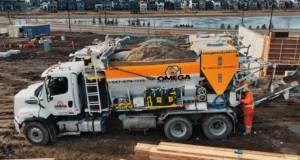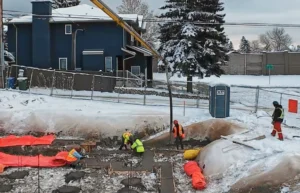
A volumetric mobile mixer carries cement, sand, stone, and water in separate compartments and meters them continuously, so the operator can change the mix design “on the fly” (between, say, a footing mix, a slab mix, and a step or flatwork mix) in the same visit, without returning to a plant or dumping unused material.
The same job by plant ready-mix means three separate deliveries: three dispatch slots, three potential short-load fees, three discharge clocks, and three lots of leftover concrete. One metered truck collapses that into a single visit and a single bill for what’s actually poured. As Cemen Tech president and CEO Connor Deering describes it, the truck “fully sets itself… to ensure that it gets the perfect concrete out the mix auger every single time.” (Source: Equipment World.)
This article is about the multi-mix-per-trip advantage specifically. For whether a switched mix is still to spec and strength, see Is volumetric concrete as strong as plant concrete? (ASTM C685). We don’t re-argue strength here. For the full method comparison, see Volumetric vs ready mix: the honest Calgary answer.
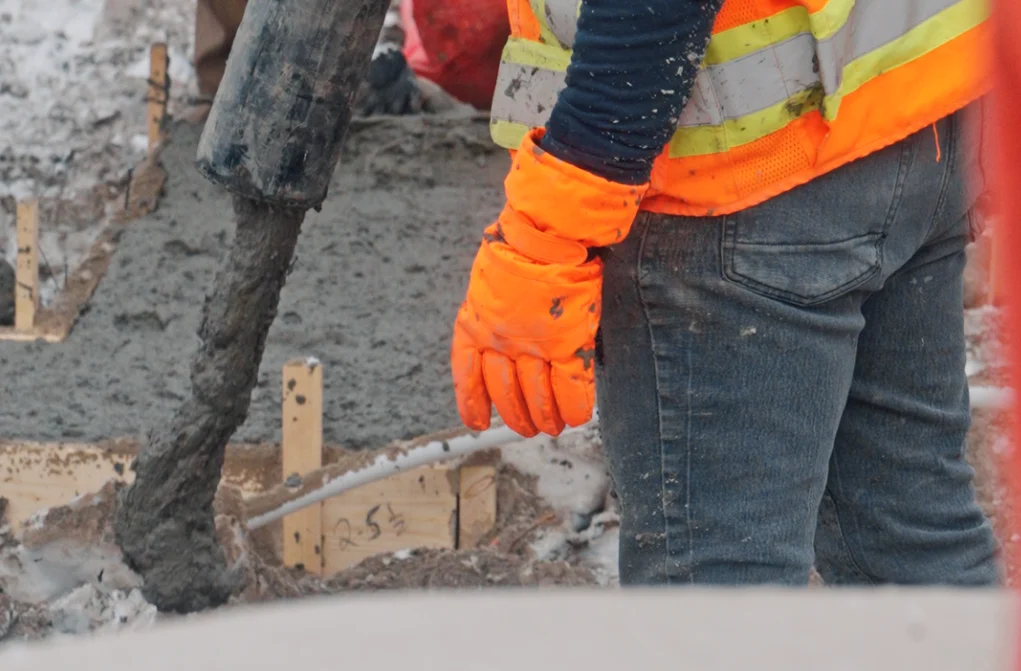
A real Calgary job needs more than one mix
Picture a common Calgary residential day: you’re pouring a garage and steps package. The footings want a sulphate-resistant structural mix for our soils. The garage slab wants a freeze-thaw-durable, air-entrained mix to survive winter. The steps and the apron want a finish-tuned mix a finisher can actually work. That’s three different design targets on one site, in one morning.
With plant ready-mix, that’s three orders. Three trucks. Three slots in the dispatch queue. Three chances for one of them to be late, three discharge clocks running, and three loads to true up against what you actually pour.
With a volumetric mixer, it’s one truck and one visit. The reason is in how the truck is built.
How one truck pours three mixes: the “on the fly” mechanism
A volumetric mixer doesn’t carry finished concrete. It carries the ingredients separately (cement, sand, stone in compartments, water and admixtures in onboard tanks) and combines them with a metered auger only at the moment of discharge. Because the mix is assembled continuously rather than pre-batched, the operator can change the recipe between pours.
Equipment World puts the mechanism plainly: with these machines, “you can change mix designs ‘on the fly’ without returning to a batch plant or dumping the unused material.” The worked example given is striking: an operator “could pour 5,000 pounds per square inch of concrete, select a different mix design through the control panel and a few seconds later, pour a low-strength, flowable fill.” (Source: Equipment World.) That’s the range one truck spans, from high-strength structural to flowable fill, which makes a footing-to-slab-to-steps switch routine by comparison.
This isn’t unique to Omega; it’s how the equipment category works. We run Calgary’s only city-based volumetric fleet, but the multi-mix capability is inherent to volumetric mixers everywhere, and the manufacturers have it on the record.
Is the second and third mix as accurate as the first?
This is the fair question, and the honest answer is that the switch is computer-controlled, not eyeballed. The metering hardware is built to re-proportion automatically when the operator selects a new design.
- ProAll describes a “variable speed cement metering auger” that “automatically adjust[s] the speed of the metering auger to meet the quantity of cement required for the selected mix design,” allowing “use of multiple mix designs with various cement content without having to manually change gears or recalibrate.” (Source: ProAll mixer lineup.)
- Cemen Tech‘s control system uses “automated gates… synchroniz[ing] the mix design with the appropriate gate setting for material flow.” (Source: Cemen Tech volumetric technology; category overview at Wikipedia: volumetric concrete mixer.)
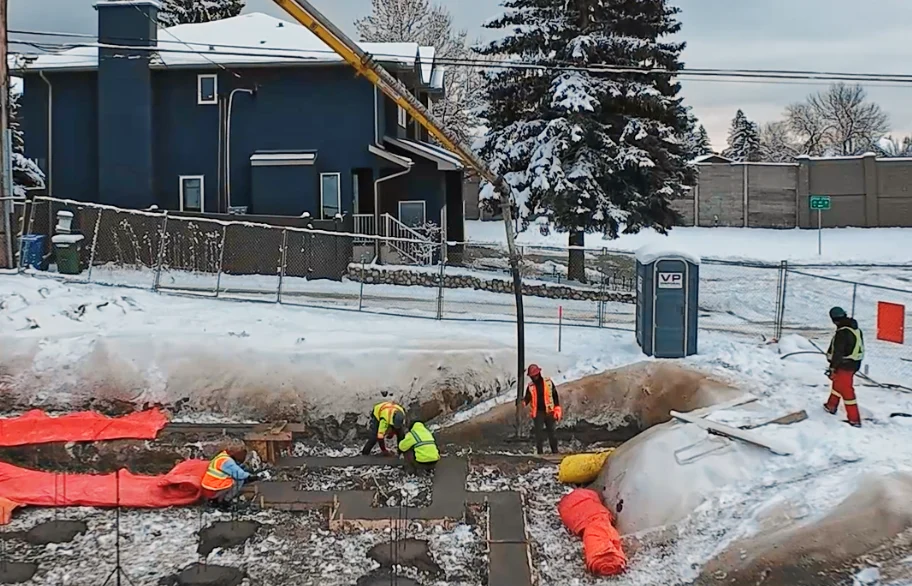
And the named voice on consistency across the switch is Connor Deering, president and CEO of Cemen Tech (the world’s largest volumetric manufacturer): “When I hit start, you’ll be able to see the gates start to move… the truck now fully sets itself… to ensure that it gets the perfect concrete out the mix auger every single time.” (Source: Equipment World.)
So each mix in the sequence is batched to its own selected design by the same metered process, not a diluted version of the first. (On strength and standards specifically, meaning whether a switched volumetric mix meets the same targets as plant concrete, the full proof is in the ASTM C685 strength article; switching mixes is a design change, not a quality compromise.)
What the three Calgary mixes actually are
The “three mixes” aren’t hypothetical: they map to real, named CSA exposure-class differences for a Calgary site. (These are CSA exposure-class examples, not Omega mix codes; sources: Calgary concrete spec / Concrete Alberta and CSA A23.1:24.)
| Element | Calgary spec driver | Mix character |
|---|---|---|
| Footings / foundation | S-2 sulphate soil (≥0.20%) on the vast majority of Calgary lots | Type HS / HSb sulphate-resistant cement; CSA A23.1:24 minimum 32 MPa @ 56 d for S-2 (35 MPa is a premium, not the minimum); w/cm ≤0.45 |
| Garage / shop slab | Freeze-thaw exposure (F-2 / C-2 class) | 5–7% entrained air for freeze-thaw durability |
| Steps / flatwork / apron | Finishability for exposed flatwork | Finish-tuned slump so the crew can work and detail it |
Three elements, three genuinely different design targets (sulphate resistance, air entrainment, finishability), and a single metered truck can hit all three in sequence. Calgary’s S-2 soils are what make this concrete rather than theoretical: the footing mix has to be Type HS, which is a real, named difference from the flatwork mix, not a tweak.
For the spec depth behind these numbers, the strength article and the comparison article carry the standards detail; here the point is simply that the differences are real and one truck can meter across them.
The plant alternative: three deliveries, three penalty stacks
Now line up what the same three-element day costs through a plant. Each mix is a separate order, and each order carries its own version of the penalties we’ve covered in the companion articles. (Illustrative synthesis tied to published third-party figures. Your Calgary quote will vary; validate locally.)
- Three dispatch slots. Each delivery is its own slot in the shared queue: three chances to get bumped behind a bigger commercial pour, three mornings-at-risk. (See Why your 7 AM pour keeps getting bumped.)
- Up to three short-load fees. If each element is a small pour, each delivery can trip its own minimum-load charge. On the published Ontario tiers (Dufferin / Ontario Redimix), that’s potentially the $400 / $250 / $150-per-load short-load charge applied three times, once per small delivery. (See The real cost of a short-load fee in Calgary for the tier math; Ontario rates, validate locally.)
- Three discharge clocks. Each load runs its own CSA A23.1 2-hour window from batching: three separate races against set time, three exposures to traffic and queue delay.
- Three lots of leftover. Order each element a little heavy “to be safe” and you can pay a returned-concrete charge (e.g., $50/m³ on the published Ontario lists) on each.
One volumetric visit collapses all of that: one trip, one slot, no per-delivery short-load stack, one continuous on-site session, and concrete metered to what each element actually takes.
The waste case: no leftover, no dumping
Multi-mix-per-trip also kills the leftover problem. Because the truck batches the exact amount of each mix, you’re not over-ordering three loads to cover three estimates.
Paul Harris, sales manager at ProAll (Reimer mixers), makes the zero-waste case directly: “That last truck out of the seven to go is volumetric. It can be used to make the last amount needed and shut it down, with no waste.” (Source: Equipment World.) The mechanism is the separate-compartment design itself: Equipment World notes these mixers “can help prevent over-ordering concrete that would otherwise be wasted,” because “their separate storage bins allow extra materials to be saved and mixed later for use.” (Same source. Note: that article also carries a Cemen Tech “save about 40 percent” figure. That is the manufacturer’s marketing claim, not an Omega promise or a general fact; we cite the waste-prevention mechanism, not the savings number.)
For why running short on any one of the three elements is its own (worse) problem, the cold-joint risk, see How much concrete do I need, and why you can’t run short.
Does switching mixes mid-job create a cold joint or a weak seam?
No. And it’s worth separating two different things. A cold joint is what happens when a pour is interrupted long enough that placed concrete starts to set before the next concrete arrives against it. Switching mix designs is not a pour interruption of that kind: it’s a recipe change between elements (footing, then slab, then steps), each placed as its own continuous pour, often in separate forms.
The flush-and-switch between designs is quick (on the order of a few minutes), and each element is poured continuously within itself. Where one element genuinely abuts another and continuity matters, that’s handled with proper joint detailing the same way any multi-element pour is. (The cold-joint mechanism and how to avoid the accidental kind is covered in the run-short article; the strength/standards reassurance is in the C685 article.)
When three separate plant loads are still the better call
The honest limit: the multi-mix advantage is about several different, modest-sized elements in one visit. If even one of your three elements is a large single-spec pour (say a big slab of 8 m³ or more on an accessible site), a dedicated drum truck for that element is often the better economic call, because a full load carries no short-load fee and drum throughput is hard to beat. A sensible day can be mixed: a drum truck for the big single-spec slab, on-site mixing for the smaller multi-spec elements. The one-truck-three-mixes case is strongest when you have multiple small-to-medium elements with different designs, not one giant single-mix pour. For the full when-to-use-which logic, see the comparison article.
FAQ
Can one concrete truck pour more than one mix design in a single visit? Yes, a volumetric mixer can. It carries the ingredients (cement, sand, stone, water) separately and meters them continuously, so the operator can select a different mix design and pour it moments later, without returning to a plant. A footing mix, a slab mix, and a step mix can all come from one visit.
How does a volumetric mixer change mixes without going back to the plant? The dry materials are stored in separate compartments and combined only at discharge by a metered auger. To change the mix, the operator selects a new design and the system re-proportions automatically. ProAll’s variable-speed cement auger and Cemen Tech’s automated gates adjust cement content per design without manual recalibration.
Footing, slab, and steps need different concrete: do I have to book three deliveries? With plant ready-mix, typically yes: three mix designs usually mean three orders, three dispatch slots, and potentially three short-load fees. With volumetric on-site mixing, one visit covers all three, because the truck switches designs on the fly between pours.
Is the second or third mix as accurate as the first? Yes, each is computer-metered to its own selected design, not an eyeballed approximation. ProAll and Cemen Tech both build automatic re-proportioning into the metering system, and Cemen Tech’s CEO describes the truck setting itself to deliver the correct mix each time. (For strength and standards specifically, see the ASTM C685 article.)
How does one-truck-three-mixes save money versus three plant loads? One visit means one trip and one dispatch slot instead of three, no triple short-load-fee exposure, one continuous session instead of three discharge clocks, and concrete metered to what each element actually takes instead of three over-ordered loads. (See the short-load fee article for the per-delivery fee math.)
Does switching mixes mid-job create a cold joint or weak seam? No. A cold joint comes from interrupting a single pour long enough that concrete starts to set; switching mix designs is a recipe change between separate elements, each poured continuously. Where elements abut, normal joint detailing applies. (The cold-joint mechanism is covered in the run-short article.)
What kinds of Calgary jobs benefit most from multi-mix-per-trip? Multi-element residential and light-commercial days, such as a foundation footing plus a garage slab plus steps, or a footing mix plus a flatwork mix on a single-family foundation day, where each element has a genuinely different design (sulphate-resistant Type HS, air-entrained freeze-thaw, finish-tuned flatwork). The more distinct modest-sized elements, the bigger the one-visit advantage.
When are three separate plant deliveries still the better choice? When one element is a large single-spec pour (roughly 8 m³ and up) on an accessible site: a full drum truck for that element carries no short-load fee and wins on throughput. A mixed approach (drum for the big slab, on-site mixing for the smaller multi-spec elements) is often the smart call.