
Chute rinse water has exactly three legal destinations on an Alberta site: a leakproof containment that holds it until the solids set, a licensed hauler that takes it away as wastewater, or a designed reuse back into the batching process. It does not go on the ground, it does not go down a catch basin, and it does not go into the ditch at the back of the lot. The City of Calgary lists cement among the substances that may not be discharged into a storm drain, and a first offence under the stormwater rules carries a fine of $75 to $3,000.
This page is about the water leaving the truck. Water going into the truck is a separate qualification question governed by the mixing water requirements in the concrete standards, and it deserves its own page. Everything below concerns the five to ten minutes at the end of a discharge that nobody puts on a schedule.
Why wash water is treated as a controlled waste, not as dirty water
Fresh cement paste is strongly alkaline, and rinse water carries that alkalinity with it. The Minnesota Pollution Control Agency describes liquid concrete wash water as “a caustic material due to a high pH” that “contains hazardous metals such as chromium.” Concrete Alberta puts the same point in field language: wash-off water is “highly alkaline, silty and may contain harmful chemicals,” and wash water discharged into storm sewers “may drain into fish bearing streams causing fish kills and habitat damage.”
Two properties do the damage. The first is pH: a discharge well above the range aquatic life tolerates will kill fish long before anything settles out. The second is suspended solids: fine cement and silt smother gravel beds and gill tissue even when the pH has been neutralised downstream. That combination is why wash water is regulated as a waste stream rather than as stormwater with a bit of grit in it.
The volumes are not trivial either. Concrete Alberta puts the wash-off water for a single exposed aggregate double driveway at approximately 500 litres. That is a half cubic metre of caustic slurry generated by one residential finish, and the pit that holds it has to be sized before the truck arrives rather than scraped out of the lawn afterward.
The four streams, and why they get confused
Talk about “washout” on a jobsite and you are usually talking about four different materials that need four different answers.
| Stream | What it is | Where it goes |
|---|---|---|
| Chute and hopper rinse water | Water used to clean the discharge path after a load | Leakproof containment; decant or haul as wastewater |
| Drum wash water | Water added inside the drum, usually back at the plant | Plant-side settling and reuse, not a jobsite problem |
| Returned plastic concrete | Unused fresh concrete still in the truck | Back to the plant, cast into blocks, or placed in a designed fill |
| Hardened washout solids | Set material broken out of the containment | Managed as clean concrete rubble for crushing or recycling |
Most compliance failures happen because the first and the third get treated as the fourth. Hardened concrete is inert and easy to place. Plastic concrete and rinse water are not, and the window in which they are a problem is short enough that people talk themselves into the ditch.
What a compliant containment looks like
Guidance across North American jurisdictions converges on the same handful of rules, and none of them require expensive equipment:
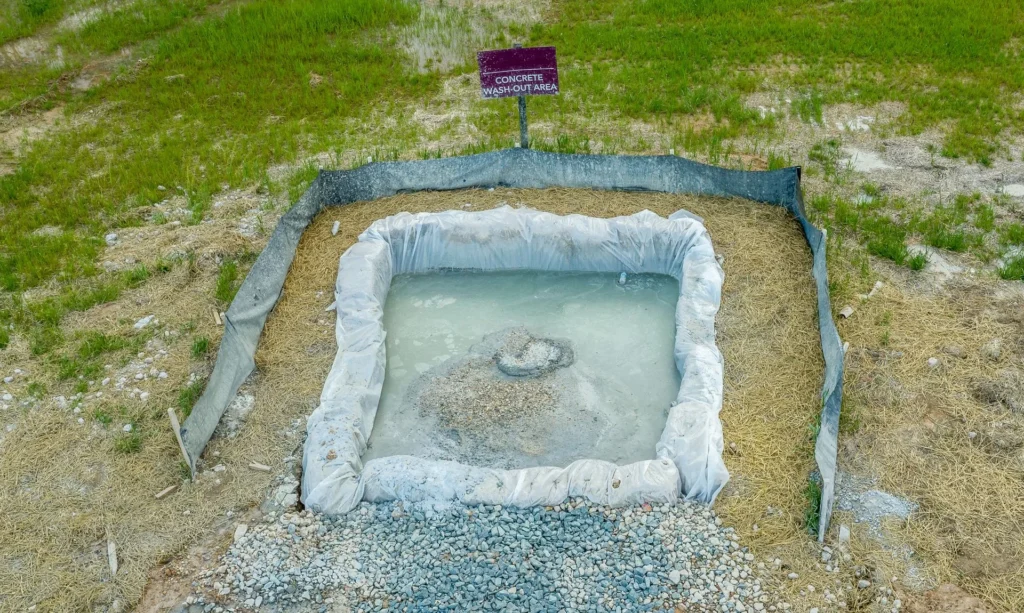
- Leakproof, and no contact with the ground. The Minnesota guidance is blunt: “liquid and solid washout wastes must be contained in a leakproof container and cannot contact the ground.” That means a lined pit or a purpose-built bin, not a hole in the subgrade.
- Set back from anything that drains. Clean Water Services guidance asks for the washout area to be kept “at least 50 feet from streets, storm drains, open ditches and streams” — roughly 15 m. On a tight infill lot that is the single hardest constraint to satisfy, and it is the reason a portable bin often beats an excavated pit.
- Below grade where possible, to maximise containment. A pit built below the surrounding surface contains a splash or an overtopping event instead of exporting it.
- Managed at 75 percent capacity. Clean Water Services notes that “overflow potential is high when the concrete washout is at 75% or greater capacity.” Treat three-quarters full as full; that is the number the site superintendent needs, not the theoretical volume.
- Liner integrity checked, not assumed. An impermeable plastic or vinyl liner does its job until a rip develops, at which point the containment has quietly become an infiltration pit.
On the burial question, jurisdictions differ and Alberta operators should not assume a permissive rule applies here. Minnesota, for example, allows up to 0.5 cubic yards of concrete solids to be managed on site provided they are at least two feet below the surface and not within three feet of the groundwater table. That is a limited allowance for set solids in one jurisdiction, not a licence to bury slurry in Alberta. Confirm with the municipality before anything goes under grade.
The Alberta and Calgary rules that actually bind
Three layers apply to a Calgary-area site, and it is worth knowing which one you are standing in.
Storm drains — prohibited outright. The City of Calgary’s storm drain rules list the substances that may not be discharged, and cement appears on that list alongside soil, solvents, paint and detergents. Fines for violations run from $75 to $3,000 for a first offence. There is no volume threshold that makes a chute rinse acceptable.
Sanitary sewer — permitted route, but not a free one. Wastewater in Calgary is governed by Wastewater Bylaw 14M2012, and businesses that haul wastewater need a hauled wastewater permit. The practical translation: decanted washout water can be handled as wastewater by someone licensed to handle it, but “someone pulled the plug on the pit and let it run to the curb” is not that route.
Spills and releases — report immediately. Concrete Alberta directs operators to “report spills immediately to 311 or Alberta Environment’s Hotline at 1-800-222-6514.” Put that number in the site phone list next to the utility locate number. A prompt call is a manageable event; a discovered discharge is not.
The Alberta climate problem nobody plans for
Containment guidance is written for temperate sites, and a Calgary shoulder season breaks several assumptions at once.
A lined pit that works in July is a solid block of frozen slurry in late October, and a frozen washout cannot accept the next load. Freeze-thaw cycling also works liners hard: water that migrates under a liner and freezes lifts and splits it, so a pit that passed inspection in September is not necessarily contained in November. A chinook makes it worse rather than better, because a pit that thaws from the top down releases liquid over a still-frozen base that has nowhere to go but sideways.
Three field habits handle it:
- Size for the week, not the load. In cold weather the decant step stops working, so containment volume has to cover several days of rinse water rather than one.
- Keep the washout off the frost line and out of the drainage path. A pit sited in the low corner of the lot will accept snowmelt all spring.
- Switch to bins when the ground is frozen. Excavating and lining a pit in frozen subgrade produces a poor liner seat. A portable, leakproof bin removes the argument.
Cold-weather placement has its own set of rules that we cover elsewhere; what matters here is that the waste stream needs a winter plan of its own, and it rarely gets one.
The cheapest fix is generating less of it
Every litre of rinse water and every cubic metre of returned concrete is a disposal problem you paid to create. Two upstream decisions shrink both.
Order closer to the real number. Over-ordering produces returned plastic concrete, which is the hardest of the four streams to place legally. Our concrete calculator and the reasons a load comes back are worth reading before the order goes in, and no-minimum-order delivery exists precisely so a small shortfall does not force an oversized order.
Mix what you need, where you need it. Volumetric on-site production changes the arithmetic on this page more than any containment design does. Material is proportioned and mixed at the point of placement, so the volume that comes back is the volume you chose not to mix, and the rinse water generated at the end of the job reflects one discharge path rather than a drum. On rural and acreage work, where the nearest legal disposal route may be an hour away, that difference is the whole job.
The rest is discipline: know what the numbers on your batch ticket are telling you about what was actually delivered, and treat the washout as part of the concrete work safety plan rather than as cleanup. Caustic slurry is a skin and eye hazard for the person shovelling it out, not only an environmental line item.
Who is responsible
Responsibility follows control of the discharge, and on most sites that means it is shared. The supplier controls the truck and the chute. The site controls where the chute is rinsed and what is there to catch it. A driver asked to rinse onto bare ground is being asked to create a release on someone else’s property, and a site that provides no containment has made that the default.
Settle it before mobilization, in one sentence: the site provides a compliant washout location, and the driver uses it. Our drivers will ask where the washout is. Having an answer that is not “over there somewhere” is the entire compliance program for most residential and light commercial pours.
FAQ
Can I let washout water soak into the ground on a large rural property? No. Guidance is consistent that liquid washout waste must be contained in a leakproof container and must not contact the ground. Distance from a watercourse reduces the consequences of a release; it does not make the discharge permitted.
How long until the solids in a washout pit are safe to break out? Until the material has hardened and the free water has been decanted or evaporated. There is no fixed hour figure, because it depends on the mix, the depth and the ambient temperature. Hardened solids are inert concrete rubble and can be crushed or recycled.
Is the decanted water usable in the next batch? Recovered water can be used in production, but only where it is characterised and controlled against the mixing water requirements in the concrete standards. That is a plant-side process with testing behind it, not a site-side decision to pump a pit into a mixer.
Does a small pour need a washout area at all? Yes. An exposed aggregate double driveway alone generates roughly 500 litres of wash-off water. The volume scales down, but the pH does not.
What if washout water has already reached a storm drain? Report it immediately to 311 or Alberta Environment’s hotline at 1-800-222-6514, and record what was discharged and when. Reporting promptly is treated very differently from a release discovered later.
Sources
- Concrete Alberta — Safe Disposal
- City of Calgary — Bylaws related to storm drains
- City of Calgary — Wastewater Bylaw 14M2012 FAQs
- Minnesota Pollution Control Agency — Concrete, paint, stucco and other washout guidance