
A mix design failure announces itself at 28 days. A road ban announces itself at 6:40 on pour morning, when the dispatcher calls to say the loads are coming in lighter than the schedule assumed and the last truck will not arrive until after the crew has lost the surface. The ban was published weeks earlier. Nobody on the order read it, because a road ban looks like a trucking problem rather than a concrete problem.
It is both. A ban does not change your mix, your strength or your exposure requirements — it changes how much concrete can legally ride on each axle group reaching your site, and therefore how many trucks, how long the pour window stretches, and whether a continuous placement stays continuous.
What a road ban actually restricts
A road ban is a temporary limit on the maximum weight allowed on a specific road, imposed, in the province’s own words, “to prevent damage during weak or thawing conditions.” The restriction attaches to the road, not to the vehicle and not to the cargo. The same truck that is legal on one highway is overweight two kilometres later.
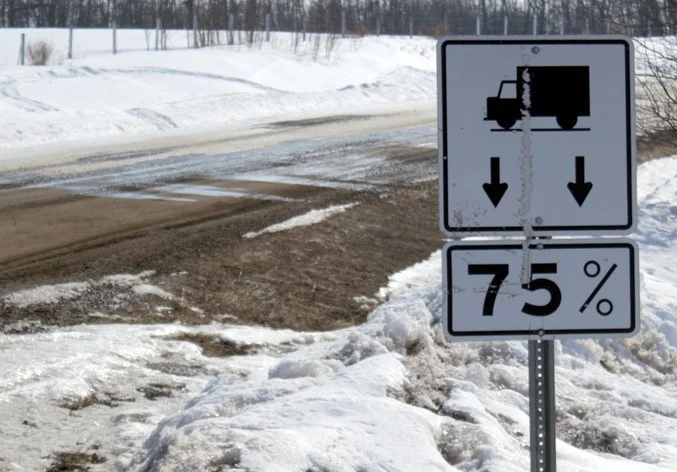
Alberta expresses bans as a percentage of the legal carrying axle weight, and the published levels are 100%, 90%, 75% and 50%. The provincial Road Ban List is organised by jurisdiction: provincial highways first, then access roads from provincial highways, then roads under provincial jurisdiction on Indian Reserves, Metis Settlements and Improvement Districts. Each entry names the highway, describes the segment by junction or kilometre marker, and assigns the percentage. Everything not listed sits at 100%.
Two details in that document matter to a pour. The list is replaced as conditions change rather than amended — the current edition, 26-ROAD-11, took effect at 1:00 pm on Wednesday, July 15, 2026, superseding 26-ROAD-10. And some restrictions carry their own overriding rule: tridem axle groups with an axle spread of 2.4 metres to less than 3.0 metres may not exceed 21,000 kilograms on 90% axle weight road sections, regardless of what the percentage alone would allow.
Where the percentage lands: the axle numbers underneath it
A percentage is only useful once you know what it reduces. For a tandem truck — the configuration most concrete is delivered in — Alberta’s weight and dimension specification sets a maximum of 5,500 kg on the steering axle during the non-winter period and 17,000 kg on the tandem axle group.
Run the percentages against that tandem group and the planning consequence becomes arithmetic rather than opinion. A 90% section leaves 15,300 kg on the tandem. A 75% section leaves 12,750 kg. A 50% section leaves 8,500 kg — roughly half the carrying capacity the schedule was probably built on.
Translating that into loads requires one assumption stated out loud: at an assumed 2,400 kg per cubic metre of normal-density concrete, every cubic metre you remove from a load frees about 2,400 kg of axle weight. On a 75% section, the reduction a carrier has to find is 4,250 kg on the tandem alone — close to two cubic metres per trip. A 40 m³ slab that was planned as five loads becomes seven or eight, and the gap between trucks is what decides whether you get a cold joint.
The same specification sets out a winter weight regime with higher limits on designated green, blue and yellow routes, but those limits are tied to frozen conditions, a winter weight permit and a validated route map. They are not a general seasonal allowance, and no concrete order should be planned around them unless the carrier confirms the route and the permit in writing.
Why the trigger is a probe reading, not a calendar date
Spring bans do not start on a fixed date, which is the single most common planning error we see. Alberta monitors frost and thaw at 70 probe stations across the province, and the seasonal weight periods turn on those readings. For heavy haul, the spring period begins when thaw depth readings reach at least 25 cm; the post-thaw period begins June 16, which may move a week in either direction; summer begins July 1; fall begins September 1; and the winter period starts when frost depth readings reach 75 cm or more.
The practical consequence for a March or April pour date in Alberta is that the restriction governing your access road may not exist when you place the order and may exist when the trucks roll. If a pour is scheduled inside the thaw window, the order needs a check within a few days of the pour, not at the time of booking.
Carriers and buyers can subscribe to the province’s one-window notification service, which emails road ban orders and seasonal weight changes as they are issued, and provincial highway ban information is available by phone at 1-855-ROADBAN (1-855-762-3226). Putting one person on that subscription list is the cheapest control available on this entire problem.
Which authority governs the road your truck finishes on
Almost every delivery ends on a road the province does not control. Bans on local roads are set by the county or municipal district office, and the provincial list explicitly directs readers to the appropriate jurisdiction for current and specific information. A site can therefore sit behind two different restrictions at once: a provincial percentage on the highway and a separate municipal percentage on the range road.
For Calgary-area acreage and rural work, Rocky View County publishes its own bans and its own lift dates — the county’s spring bans were lifted on Monday, June 8, 2026. It also runs its own permit channels: an annual agricultural permit, over-weight and over-dimension permits through Road Data Services, and a requirement that special approvals such as heavy hauls or travel on banned roads be requested a minimum of three business days ahead.
Three business days is the number to design around. It is longer than most pour decisions take, and it is the reason a rural order needs its route confirmed at booking rather than the night before. We treat the broader access and equipment economics of out-of-town work in our guide to concrete pumping costs in rural Alberta.
Why some roads sit below 100% even when bans are lifted
This is the clause that catches experienced buyers. When Rocky View County lifts its spring bans, paved and gravel roads return to 100% of the legal carrying axle weight — but chip-sealed and oil-surfaced roads return to 90%, with exceptions in both categories. The county publishes a road surface map precisely so that carriers can tell which surface they are on.
So “the bans are off” is not the same statement as “the road is at 100%.” On a chip-sealed approach, the 10% reduction is structural and year-round. If your site’s last two kilometres are oil-surfaced, the delivery plan carries that reduction permanently, and the load count should be built on it rather than discovered through it.
What the exemption permit does and does not do
Alberta does provide relief. Some vehicles qualify for an exemption under Section 12(5) to 12(7) of the Commercial Vehicle Dimension and Weight Regulation; others can apply through the Central Permit Office using the Road Ban Exemption Permit Request form.
What a permit does not do is move the physical limit of a thawing road, and it does not arrive on the day it is asked for. Treat the exemption route as a planning tool for a known, scheduled, high-volume placement — a raft slab, a large footing pour, a continuous commercial placement — rather than as a fix for a ban discovered on pour morning.
How to plan a pour date around a ban
| When | What to confirm | Who holds the answer |
|---|---|---|
| At booking | Full route from plant to site, including the final access road and its surface type | You and your supplier, jointly |
| At booking | Whether any segment is chip-sealed or oil-surfaced and therefore below 100% | Municipal road authority’s surface map |
| At booking | Whether a municipal special approval is needed, and its lead time | County or MD office |
| 1 week out | Current provincial and municipal ban status on every segment | Road ban list, one-window notifications, county dashboard |
| 2 to 3 days out | Final load count and truck interval against the restricted axle weight | Your supplier’s dispatch |
| Pour morning | Confirmed truck spacing and the placement sequence it supports | Your crew and dispatch together |
A ban that is known a week out is a load-count adjustment. The same ban discovered on the morning is a cold joint, and the documentation of what actually arrived — load by load — is the record you will be reading afterwards, which is why the numbers on a concrete batch ticket are worth understanding before the first truck, not after the last one.
Get the route priced before the ban decides for you
Road bans are a supply problem with a concrete consequence, and they are solvable almost entirely at the ordering stage. Tell us where the site is, what the last two kilometres look like, and when you intend to place, and we will build the delivery plan against the restriction that will actually be in force.
Send us your project details — pour date, mix type, PSI, volume — and our team will get back to you within 1 business hour with a quote and delivery slot. See custom mixed concrete in Calgary for how a mix is proportioned to the placement, our rural projects page for out-of-town access, or our Calgary concrete cost guide for how access and volume move a price.
FAQ
Do road bans apply to concrete trucks? Yes. Road bans apply to commercial and heavy vehicles by road, not by cargo type. A ready-mix truck travelling a 75% section is subject to the same reduction in legal carrying axle weight as any other commercial vehicle on that segment.
What does a 75% road ban mean in kilograms? It means 75% of the legal carrying axle weight for that axle group. For a tandem truck, where the non-winter limit is 17,000 kg on the tandem axle group, a 75% section leaves 12,750 kg, and a 50% section leaves 8,500 kg.
When do spring road bans start and end in Alberta? There is no fixed start date. The province monitors frost and thaw at 70 probe stations, and the spring period for heavy haul begins when thaw depth readings reach at least 25 cm. The post-thaw period begins June 16, subject to a week either way. Municipalities set and lift their own bans separately — Rocky View County lifted its 2026 spring bans on June 8.
Who sets road bans on a rural access road? The county or municipal district. The provincial Road Ban List covers provincial highways and certain roads under provincial jurisdiction, and directs carriers to the local road authority for everything else. A rural site often sits behind both a provincial and a municipal restriction.
Can a ban be lifted for one delivery? Not lifted, but sometimes exempted. Some vehicles qualify under Section 12(5) to 12(7) of the Commercial Vehicle Dimension and Weight Regulation, and others can apply to the Central Permit Office. Municipal special approvals carry their own lead times — Rocky View County asks for a minimum of three business days.
Sources
- Road restrictions and bans overview, Government of Alberta: https://www.alberta.ca/road-restrictions-and-bans-overview
- Road Ban List 26-ROAD-11, Alberta Transportation and Economic Corridors: https://www.transportation.alberta.ca/content/doctype260/production/trans-road-bans-list.PDF
- Commercial Vehicle Weight and Dimension Specification — Tandem Truck, Alberta Transportation: https://www.transportation.alberta.ca/content/doctype276/production/teg060.pdf
- Road Bans, Rocky View County: https://www.rockyview.ca/road-bans