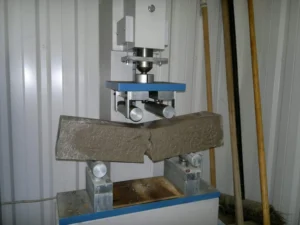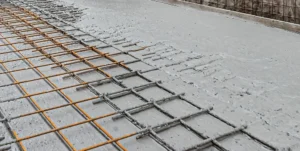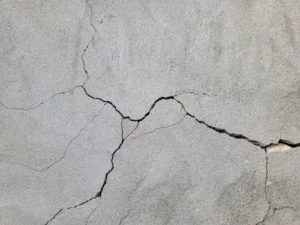


A homeowner in Auburn Bay watches the concrete crew pour a 28′ × 24′ driveway on a warm May 2026 morning. The mix looks stiff. The crew foreman asks the driver to “add a bit of water.” The driver pulls the hose. The driveway looks beautiful at finish. Two winters later, the surface is spalled to the rebar.
Nobody on that driveway did anything obviously wrong. The concrete was ordered. The crew finished it cleanly. And yet the slab failed — not because the concrete was weak, but because the one parameter that protects a Calgary driveway from freeze-thaw was quietly destroyed in the four minutes between the truck and the form. That parameter is entrained air, and most homeowners don’t know it exists until the surface starts coming apart.
This is the homeowner’s pour-day checklist: eight questions to ask the supplier and the crew, each with the standard behind it. You are not pouring the concrete. You are the buyer, the inspector on the spot, and — two winters from now — the only person who will be holding the warranty conversation. These eight questions cost nothing to ask, and they protect every cubic yard you pay for.
First, a 30-second primer on why air matters. Concrete absorbs water. In Calgary, that water freezes and thaws across the City of Calgary’s Climate Hazards Report 30-year average of roughly 128 freeze-thaw cycles a year (the methodology counts every crossing of 0°C, so the number reflects how often water in your slab actually freezes and thaws, not just the coldest days).
Each time the trapped water freezes, it expands about 9%. Without somewhere to go, that expansion cracks the cement paste from the inside, and the surface flakes off — what you see as spalling and scaling. Air entrainment solves this by deliberately whipping millions of microscopic air bubbles into the fresh mix. Those bubbles are the escape valves: when water freezes, it pushes into the empty bubbles instead of fracturing the concrete.
If you’d like a deeper explanation of how the air-void system works—and why it matters so much in Alberta’s climate—read our guide to Air-Entrained Concrete: Essential for Calgary Climate.
The target for a typical Calgary driveway is 5–8% of the total volume. Below about 4% air, freeze-thaw protection collapses. That single band of numbers is what the first six of these questions are really protecting.
1. What exposure class is my driveway specced to?
Scene: A first-time homebuyer in Walden gets three driveway quotes in 2026. Two suppliers quote “5,000 psi concrete.” One quotes “CSA A23.1:24 C-2 exposure class — 32 MPa at 28 days, 5–8% entrained air, w/cm ≤ 0.45.” She doesn’t know the difference, so she picks the cheapest “5,000 psi.”
Here is the fact behind the question. CSA A23.1:24 (the current 14th edition) classifies concrete by the environment it has to survive, not just by how strong it is. For a Calgary residential driveway that will see road salt or de-icing chemicals tracked off vehicles — which is almost every driveway — the typical specification is C-2 exposure: 32 MPa at 28 days, 5–8% entrained air, w/cm ≤ 0.45.
For flatwork that genuinely never sees de-icing chemicals, F-1 applies: 32 MPa at 28 days, the same 5–8% air, with a more relaxed w/cm ≤ 0.55. The exposure class is the line of the spec that bundles strength, air, and water-cement ratio into one durability requirement.
“5,000 psi” is the compressive strength alone — roughly 35 MPa in metric. It tells you how hard the concrete is to crush. It says nothing about air content, w/cm ratio, or freeze-thaw exposure. A 5,000 psi mix with no entrained air will scale in a Calgary winter at the same rate as a weak 3,000 psi mix, because crushing strength and freeze-thaw durability are two different properties. Strength resists load. Air resists frost. You need both, and only the exposure class guarantees both.
This matters because exposure class is the spec language that lets you compare quotes honestly. When one quote says “C-2, 32 MPa, 5–8% air, w/cm ≤ 0.45” and another says “5,000 psi,” they are not describing the same product — even if the second one is a higher number on paper. The homeowner who asks “what CSA A23.1:24 exposure class is this specced to?” can put three quotes side by side and see which suppliers are quoting a freeze-thaw-durable mix and which are quoting a number that sounds impressive and protects nothing.
Once the exposure class is locked, the next question is whether the mix that shows up actually carries the air that class requires.
2. What percent entrained air is in this load — measured at discharge?
Scene: A homeowner-builder in Bearspaw is on-site for an acreage shop slab pour in June 2026. The truck arrives and the crew sets up. He asks: “What’s the air content?” The operator says “5–8%, per the mix design.” He asks again: “What is it measured at, today, at discharge?” The operator runs a pressure-meter test on a fresh sample. Result: 6.2%. The pour proceeds — now with a number on paper.
CSA A23.1:24 specifies the entrained-air range for each exposure class and points to the standard field test for measuring it (a pressure-meter method run on a sample taken from the truck).
The number that governs your slab’s freeze-thaw life is the air content measured at the point of discharge — not the target printed in the mix design. The design says what the plant intended to deliver. The discharge measurement says what actually arrived after the concrete rode in the truck, sat in traffic, and met the Alberta weather.
That distinction is not academic. Vibration, time, temperature, and pumping can all shed air between batching and placement, and the gap between the design target and the measured-at-discharge value can run a full percentage point or more depending on the haul.
A mix designed at the top of the 5–8% band can arrive at the bottom of it — or, if water was added en route, below it. “Per the mix design” is a statement of intent; “6.2% measured at discharge” is a statement of fact, and only one of those protects you in February.
So the homeowner who asks for the measured number gets the figure that actually decides whether the slab survives — and, by asking, signals to the crew that someone is paying attention, which quietly changes behaviour for the rest of the pour.
A delivery-method note worth knowing: a volumetric mixer batches concrete continuously on-site and injects the air-entraining admixture at discharge, allowing per-load air adjustment on the truck. It meets the same ASTM C685/C685M-25a and CSA A23.1:24 air-content requirements as plant-batched ready-mix, and the air should still be measured at discharge on every load. The point isn’t which truck; it’s the number on the meter.
Measurement at discharge is the right value to lock in. The next question protects that value from the most common way it gets destroyed.
3. Will any water be added to the mix between the truck and the form?
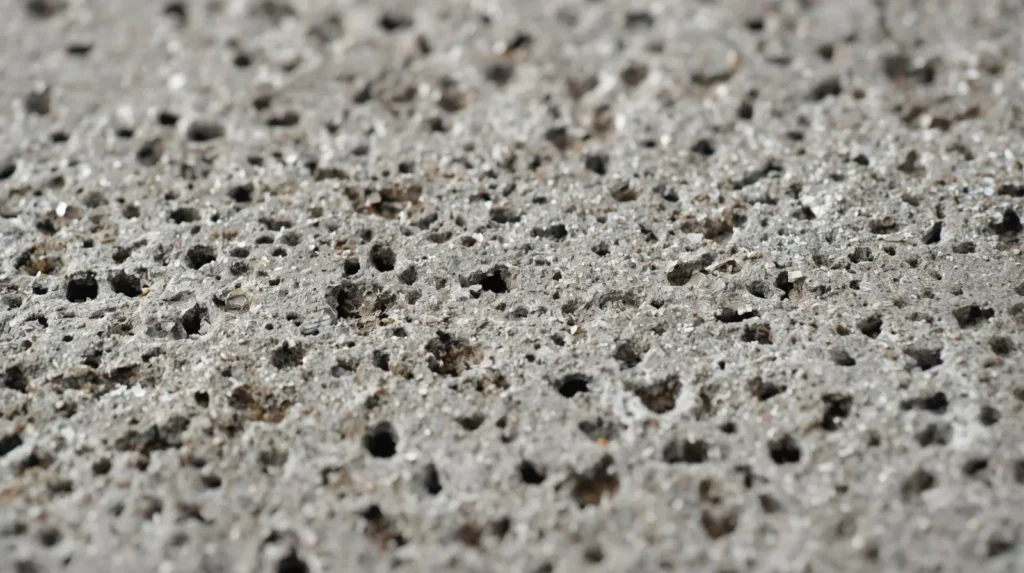
Scene: A homeowner in Killarney watches a driveway pour in late April 2026. The mix looks stiff coming off the truck. The crew lead — trying to get a clean finish — calls for “just a little water.” The driver tempers in a few gallons. The mix works easier and the finish looks great. Three winters later, the driveway has popouts the size of dimes across the whole surface.
Adding water beyond the design water-cement ratio is the single most common way an in-spec load turns into an out-of-spec slab. Two things happen at once. First, the extra water dilutes the paste and lowers the concrete’s strength roughly in proportion to how much water-to-cement you’ve added.
Second — and this is the part nobody warns the homeowner about — the extra water and the re-mixing destabilize the entrained-air system. Those carefully whipped-in micro-bubbles coalesce and escape, and the air content drops. The mix that left the plant at 6% can land in the form at 4% or below.
That drop is the whole ballgame. The freeze-thaw protection you paid for lives in the air-void system, so a small loss of air translates into a large loss of durability, and dropping below roughly 4% air collapses the protection almost entirely. A few gallons of “make it easier to finish” water, added with the best intentions on a warm afternoon, is often the exact mechanism that produces a driveway that scales in Year 2. The concrete that was ordered would have survived. The concrete that got placed will not.
This matters because the fix is free and entirely in your hands as the buyer. You only need to say, out loud, on pour day: “No water added at the site — if the mix is too stiff, we adjust with a water-reducing admixture or we send it back, but we don’t temper it with the hose.” A reputable crew and supplier will agree, because that’s how the spec is supposed to work. If the mix genuinely arrives too stiff, that’s a slump conversation (the next question), and the right answer is a chemical admixture dosed to hold the air — not a garden hose.
Water discipline at the site is one input you control. The next question is how you verify the supplier sent the mix at the right consistency in the first place — so the temptation to add water never comes up.
4. Was the slump measured at the truck — and what was it?
Scene: A homeowner in Inglewood is on-site for a garage slab pour in October 2026. The slump cone is set up beside the truck. The crew runs the test: 110 mm. The mix design called for 80 ± 20 mm — so 110 mm is right at the top of tolerance, but inside it. The load is accepted and placed with no water added. The test took two minutes and it settled the “is this too stiff?” question with a number instead of a hose.
Slump is the on-site measurement of how fluid the fresh concrete is, run by dropping a cone-shaped sample and measuring how far it slumps. CSA A23.1:24 specifies a slump tolerance around the mix-design target and references the standard slump-test method.
The reason slump matters to a homeowner is that it is the verification that the supplier delivered the concrete at the designed water-cement ratio. A load that arrives at the right slump arrived at the right water content. A load that arrives too stiff and then gets watered to loosen it has had its verification reversed — you can no longer trust that the w/cm and the air are what the spec called for.
Here’s the subtle part. A measured 110 mm slump that is within tolerance is a clean acceptance — that’s just how fluid the mix was designed to be. But a measured 60 mm slump that the crew tempers up to 110 mm with site water is the opposite of acceptance, even though the concrete ends up looking identical in the form.
Same final appearance, completely different durability. The slump test only protects you if it’s run before any water is added and the result is recorded. Run after tempering, it tells you nothing — it just confirms the water you didn’t want is now in the mix.
This matters because the slump test is the single quality-control step a homeowner can actually witness on pour day. You can stand there and watch the cone get filled, rodded, lifted, and measured. You don’t need to interpret it — you just need to see that it happened and ask what the number was.
A supplier and crew who run slump on the load are operating a quality system you can verify with your own eyes. A crew that skips it and eyeballs the mix is operating on trust, and trust is exactly what fails the warranty conversation in Year 2.
Slump and air are two of the three measurable parameters at discharge. The next question covers the third — the one that gets skipped most often.
5. What temperature was the concrete at when it left the truck?
Scene: A homeowner in Tuscany is on-site for a foundation pour in late September 2026. Ambient is 8°C. The crew runs slump and air. They skip the temperature test. Two days later the test cylinders break low on 7-day strength, and the supplier and crew dispute who’s responsible — but neither can produce a delivered-concrete temperature record, so the dispute goes nowhere.
CSA A23.1:24 specifies acceptable concrete temperature ranges at delivery for both cold-weather and hot-weather conditions, measured with a simple probe in the fresh mix. Delivered temperature governs whether the curing plan will actually work.
Concrete is a chemical reaction, and that reaction is temperature-sensitive: too cold and it stalls; too hot and it races. The temperature reading on the batch ticket is the trace of how the concrete arrived, and it’s the data point that decides whether the cure protocol the crew is using is the right one.
The two failure modes sit at opposite ends. A cold-weather pour delivered too cold won’t develop strength on the design curve — the reaction slows, the early strength the slab needs to resist frost (the 7 MPa early-frost-resistance threshold) arrives late or not at all, and a slab that froze before reaching it can be permanently compromised.
A hot-weather pour delivered too warm sets faster than the finishers can keep up with, which drives rushed finishing, surface cracking, and — relevant to everything above — accelerated air loss. In Calgary’s spring and fall, where you can pour at 8°C in the morning and 22°C by afternoon, the delivered temperature is genuinely variable and genuinely worth a record.
This matters because temperature is the most-skipped of the three discharge-point measurements. Crews run slump because it’s visible, sometimes run air because the spec demands it, and routinely skip temperature because it feels redundant on a “normal” day.
But the homeowner who asks for all three — slump, air, and temperature — is asking for the complete delivery record. In the Tuscany scene above, that one skipped reading is the difference between a resolvable warranty claim and a stalemate. The test costs thirty seconds; the missing record costs the claim.
Temperature, slump, and air are the field measurements. The next question is about the document that captures them — and everything else about what was delivered.
6. Can I have a copy of the batch ticket — with mix design, time, and yardage?
Scene: A homeowner in Mahogany asks the driver for the batch ticket as the truck pulls away after a 6-cubic-yard driveway pour in July 2026. He hands her a carbon-copy slip with the supplier’s name, “6 yards,” and a timestamp. No mix-design number. No exposure class. No air content. No record of water added. Two years later, when the driveway spalls, that slip is all she has — and it proves nothing.
CSA A23.1:24 specifies the minimum information that must appear on each delivery ticket. That includes the supplier name and plant identification, the ticket number, the time of batching, the mix identification, the quantity, the cementitious and admixture quantities, and any water added at the request of the purchaser.
The batch ticket is not a receipt for payment — it is the contractual record of what was delivered, in what quantity, batched at what time. The time stamp also matters because CSA A23.1:24 sets a 2-hour discharge clock from when water first contacts the cement for drum-mix supply, and the ticket is what proves the concrete was placed inside that window.
A supplier who can hand you a complete ticket on demand is operating to the current standard. One who hands out an abbreviated slip — name, yards, time, and nothing else — is operating below it, even if the concrete in the truck happens to be perfectly in spec.
The completeness of the ticket is itself a signal: the same discipline that produces a full batch ticket is the discipline that runs the slump test, measures the air at discharge, and refuses the hose. The slip and the system travel together.
This matters because the batch ticket is the homeowner’s only durable evidence in any future dispute. Memory fades, crews move on, and “the concrete looked fine” is not a defensible position two winters later. The ticket — with the mix-design number, the exposure class it ties to, the batching time, the yardage, and the water-added line — is the paper trail the entire warranty conversation depends on.
The homeowner who insists on the full ticket, photographs it on the spot, and files it with the contract can actually prove what was delivered. The one in Mahogany cannot, and that’s the end of her claim before it starts.
Documentation is what you take home from pour day. The next question is about what the supplier is qualified to deliver in the first place — the screen you run before the truck is ever booked.
7. Is this a CSA-compliant supplier, and can I see the QC documentation?
Scene: A homeowner-developer in Bridgeland is choosing a supplier for a four-unit infill project in 2026. Two suppliers bid. Supplier A sends, on request, their quality-control documentation tied to CSA A23.1:24, a recent plant audit, and a current cylinder-testing summary. Supplier B says “we’re fully certified” and sends nothing. The developer picks Supplier A — not because B is necessarily worse, but because only A could prove it.
CSA A23.1:24 establishes supplier-qualification requirements: a compliant supplier demonstrates ongoing conformance through plant quality-control records, cylinder-testing data, and the ability to produce mix-design submittals for any specified exposure class.
“Compliant” isn’t a logo or a tagline — it’s a set of documents that exist (or don’t) and that a real supplier can email you the same day. The question to ask is simply: “Can you send me your CSA A23.1:24 QC documentation and your most recent cylinder-test summary?” The answer, and how fast it comes, tells you most of what you need to know.
“Certified” is a word; documentation is the evidence behind it. There is a meaningful difference between a supplier who replies within the day with a QC summary and a recent test report, and one who deflects with reassurance and produces nothing.
The second may still deliver fine concrete — but you have no way to know, and you’ve learned that if something goes wrong, the evidence to resolve it may not exist. For a homeowner spending five figures on a driveway, or a small developer spending far more on an infill, that’s a real signal about which supplier de-risks the project.
This matters because screening for QC documentation up front filters out, before any concrete is ordered, the suppliers most likely to produce the in-spec-mix / out-of-spec-delivery failure pattern this whole article is about. The screen costs one email and a day’s wait. It’s the cheapest insurance in the entire process, and you run it before you’ve committed a dollar.
A note on what not to over-rely on: a provincial prepaid contractor’s licence and WCB clearance are things you can and should verify yourself — the licence on Service Alberta, the WCB clearance directly — rather than taking anyone’s word that they hold them. Treat every credential as something to confirm, not assume.
Supplier qualification is the pre-pour filter. The final question is the most consequential one — what happens if, despite everything, the slab fails anyway.
8. If the slab fails freeze-thaw in Year 2, what’s the warranty path?
Scene: A homeowner in Aspen Woods notices spalling on a 2024-poured driveway in spring 2026. She contacts the supplier. The supplier asks for the batch ticket, the slump record, the air-content record, the delivered-temperature reading, and the curing documentation. She has none of it. The conversation is over before it begins — not because the supplier is unwilling, but because there’s nothing to adjudicate.
The warranty landscape for residential concrete has a gap most homeowners don’t see until they fall into it. New-home structural warranty programs in Alberta cover some elements of a new build, but driveways and exterior flatwork are commonly excluded from major-structural coverage — they’re treated as a surface element, not a structural one.
Supplier warranties, where they exist, typically require the homeowner to produce delivery and curing documentation as a precondition of any claim. In other words: the warranty path usually runs through the exact paperwork covered in questions 4 through 6. No documentation, no claim.
There’s a hard truth underneath this. The freeze-thaw failure that surfaces in Year 1 to 3 is rarely a manufacturing defect in the concrete that left the plant. Far more often it’s a documentation failure that prevents the homeowner from proving the real cause — that an in-spec load had its air destabilized by site water, or that a cure step was skipped, or that the concrete was placed too cold.
The concrete that was delivered may well have been fine. But without the ticket, the slump record, the air reading, and the cure log, the homeowner can’t demonstrate where it went wrong, and “your word against ours” almost always favours the party that didn’t sign the cheque.
This matters because asking the warranty question on pour day — before anything has gone wrong — puts the evidentiary burden on the table while everyone is still paying attention.
When you ask “if this fails freeze-thaw in Year 2, what’s the path, and what records will you need from me?”, you learn what the actual coverage is (and isn’t), and you signal that you intend to keep the documentation a claim would require — which makes everyone on-site a little more careful with the air, the water, and the ticket. The homeowner who asks gets the documentation. The homeowner who doesn’t, finds out in the spring of Year 2.
These eight questions are the homeowner’s accountability checklist. You are not the one pouring the concrete — you are the buyer who knows what to verify and the only person who keeps the records. The questions cost nothing on pour day, and together they protect every cubic yard of concrete you pay for, from the morning of the pour through the second Calgary winter and beyond.
FAQ
Q1: What percent entrained air should concrete have for a Calgary driveway? For most Calgary residential driveways — which see road salt and de-icing chemicals — the requirement is 5–8% entrained air under the C-2 exposure class in CSA A23.1:24, along with 32 MPa at 28 days and a w/cm ratio ≤ 0.45.
For flatwork that genuinely never sees de-icing chemicals, the F-1 class applies, with the same 5–8% air and a more relaxed w/cm ≤ 0.55. Below roughly 4% air, freeze-thaw protection collapses, so the 5–8% band is not optional in this climate.
Q2: What does air entrainment actually do for concrete in freeze-thaw? Air entrainment whips millions of microscopic air bubbles into the fresh mix. Concrete absorbs water, and when that water freezes it expands about 9%. The micro-bubbles give the expanding ice somewhere to go, so it pushes into the empty voids instead of cracking the cement paste from the inside.
Across Calgary’s roughly 128 freeze-thaw cycles a year (City of Calgary Climate Hazards Report, 30-year average, counting every crossing of 0°C), those bubbles are what keep the surface from scaling and spalling.
Q3: Can the driver add water to my concrete on site? Water can be added at the purchaser’s request and must be recorded on the batch ticket, but adding water beyond the design water-cement ratio is the most common way an in-spec load becomes an out-of-spec slab.
Extra water lowers strength and destabilizes the entrained-air system — air bubbles coalesce and escape, and a mix that left the plant at 6% air can land in the form below 4%. If the mix is too stiff, the correct fix is a water-reducing admixture or a slump conversation, not the hose. As the buyer, you can say “no site water” on pour day.
Q4: What exposure class is a Calgary driveway? Most Calgary driveways are C-2 under CSA A23.1:24, because they’re exposed to chemical de-icers in a freeze-thaw environment — that’s 32 MPa at 28 days, 5–8% air, w/cm ≤ 0.45. A driveway that truly never sees de-icing chemicals can fall under F-1 (32 MPa at 28 days, 5–8% air, w/cm ≤ 0.55).
The difference between the two is mainly the water-cement limit: C-2 is tighter because de-icing salts are more aggressive. Confirm the class on your quote rather than accepting a “5,000 psi” strength number that says nothing about exposure.
Q5: What should be on a concrete batch ticket? CSA A23.1:24 specifies the minimum content: supplier name and plant identification, ticket number, time of batching, mix identification, quantity, cementitious and admixture quantities, and any water added at the purchaser’s request.
The batching time also lets you confirm the concrete was placed inside the CSA 2-hour discharge window. A complete ticket is your only durable evidence of what was delivered — photograph it on pour day and file it with your contract, because an abbreviated slip showing only “yards” and a time proves nothing in a Year-2 dispute.
Q6: Does it matter whether my concrete is plant-batched or volumetric? For air content and durability, the standard is the same either way. A volumetric mixer batches concrete continuously on-site and injects the air-entraining admixture at discharge, which allows per-load air adjustment on the truck; it meets the same ASTM C685/C685M-25a and CSA A23.1:24 air-content requirements as plant-batched ready-mix.
With either delivery method, the air content should be measured at the point of discharge on every load, and that measured number — not the mix-design target — is what governs your slab’s freeze-thaw performance.
Sources
- CSA A23.1:24 / A23.2:24 — Concrete materials and methods of concrete construction (14th edition) — air content, exposure classes (Tables 2 and 4), delivery-ticket and supplier-qualification requirements — https://www.csagroup.org
- ASTM C685/C685M-25a — Standard Specification for Concrete Made by Volumetric Batching and Continuous Mixing — https://www.astm.org
- Concrete Alberta — technical bulletins — cold-weather and air-entrainment best practices for Alberta concrete — https://www.concretealberta.com
- City of Calgary — Climate Hazards Report — freeze-thaw cycle data (30-year average, every-0°C-crossing methodology) — https://www.calgary.ca
Don’t Leave Your Concrete Pour to Chance
Every driveway, garage slab, sidewalk, and patio gets one chance to be poured correctly.
At Omega Ready Mix, every load is batched to CSA A23.1:24 and ASTM C685/C685M-25a standards, with air content measured at discharge so you know exactly what arrives on site—not just what was specified at the plant.
If you’re planning a concrete project in Calgary, we’ll help you choose the right exposure class, explain your mix design, and answer your questions before the truck arrives.
Contact Omega Ready Mix
✔ Residential driveways
✔ Garage slabs
✔ Sidewalks & patios
✔ Acreage concrete projects
✔ Builder & contractor supply
Call: 403-217-4888
Email: [email protected]
Request a quote today and make sure your concrete is designed for Calgary’s freeze-thaw climate—not just poured for today.