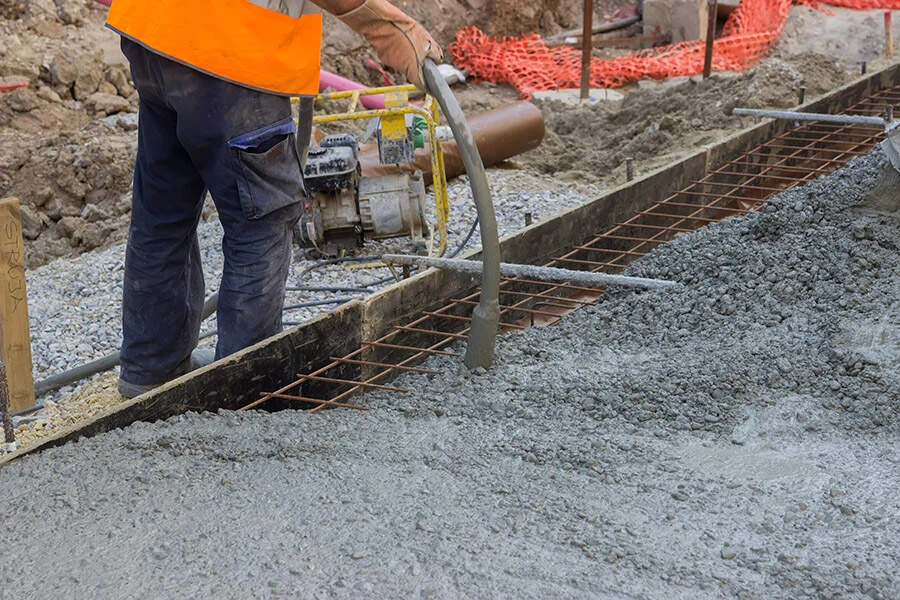
Strength is bought by number. Air content is bought by number. Slump, aggregate size and cement type are bought by number. Consolidation is the one property of hardened concrete that no line on an order can deliver, and it is the only major placement operation a specification governs mostly by eye.
That gap is not an oversight. Read a structural specification closely and a pattern appears: the equipment is specified by number, the operation is specified by what the operator can see, and the single limit written against over-vibration is not a duration at all. It is a symptom. Once you know the American Concrete Institute’s position on what produces that symptom, the limit stops reading as a warning about the crew and starts reading as a diagnosis of the mix.
What a specification fixes by number, and what it hands to judgement
Alberta Transportation’s Specifications for Bridge Construction, Section 4, Cast-In-Place Concrete, is a useful reference because it is explicit about both halves. Note the version point up front: the printing read for this article references CSA A23.1-04 and CSA-S6-06 in its reference list, and clause 4.1 provides that the version current at tendering governs. The current standard specification is Edition 17 (2020), whose full compiled text returned a server error on the open data portal at the time of writing. Clause numbers below are as printed in the section read.
| Requirement | How it is specified |
|---|---|
| Method of vibration | Internal, unless other methods receive special authorization of the Consultant (4.14.2) |
| Vibrator output | Not less than 4500 impulses per minute (4.14.2) |
| Effective radius | Must visibly affect concrete of 25 mm slump over a radius of at least 0.5 m (4.14.2) |
| Insertion spacing | Not farther apart than the radius over which vibration is visibly effective (4.14.2) |
| Insertion technique | Inserted vertically, withdrawn slowly (4.14.2) |
| Duration | Sufficient duration and intensity to thoroughly compact the concrete. No number (4.14.2) |
| Upper limit | Shall not be continued at any point to the extent that localized areas of grout are formed (4.14.2) |
| Number of vibrators | A sufficient number to properly compact each batch, with backup equipment on site as determined by the Consultant (4.14.1, 4.14.2) |
Three observations fall out of that table.
The first is that the spacing requirement is derived, not stated. There is no number for how far apart to insert, because the answer depends on the radius you can actually see working, and the radius is defined against a 25 mm slump. A wetter mix shows a wider apparent radius, which is exactly how a crew talks itself into wider spacing on a stiffer pour. Slump is therefore not only a placeability figure, it is the calibration constant for the whole spacing rule, which is why slump control is upstream of consolidation rather than parallel to it. We cover the control side of that in our note on slump control and concrete quality.
The second is that vibration must not be driven through concrete that has hardened to the degree that it ceases to be plastic under vibration. That is the clause that converts a placing rate problem into a consolidation problem, and the two are joined: each portion between construction joints is to be placed in one continuous operation, and delivery is to be scheduled so that cold joints do not develop. A lift that waits loses the ability to be knitted to the one above it, and no amount of vibrator time recovers it. That mechanism, and the forms it takes in a wall pour, is the subject of our guide to preventing cold joints in ICF foundation walls.
The third is the one worth sitting with. The only written upper bound on vibration is the appearance of localized areas of grout.
What the American Concrete Institute actually says about over-vibration
The common field belief is that holding a vibrator too long ruins a mix: segregation, and the entrained air you paid for driven out of the concrete. The Institute’s own answer to that question is more precise, and it changes where responsibility sits.
Normal density concretes that are well proportioned and have adequate consistency are not easily segregated by over-vibration, per ACI 309. A mixture with excess mortar, however, is prone to segregation when over-vibrated. On air, a well proportioned mixture with the proper air void system will lose some air during vibration, and the system will still provide satisfactory resistance to freezing and thawing, because what leaves is the large bubbles and the bubble spacing factor remains within acceptable limits. The Institute’s cited documents are SP-1(02) and ACI PRC-309.5-22. It offers no duration and no percentage of air loss, which is itself informative: the Institute does not treat time as the controlling variable either.
Put the two documents side by side and the logic closes. The specification’s stop signal is the formation of localized grout. The Institute says grout and mortar separation under vibration is characteristic of a mixture carrying excess mortar. The field symptom used as an operating limit is also the tell-tale of a proportioning decision made before the truck left the plant.
What that means for who owns the defect
It reframes a familiar argument on site. When grout runs at the form face and the finisher calls for less vibrator time, the crew has correctly identified a symptom and incorrectly identified the cause. Less vibration will reduce the grout and will also reduce consolidation, trading a visible defect for an invisible one: honeycombing behind the face and voids around congested steel, neither discovered at the time and neither corrected by finishing.
The useful question is not how many seconds. It is whether the mortar fraction is right for the section being filled. A congested wall with a small nominal maximum aggregate size carries more mortar per cubic metre by design, and the more mortar a mix carries, the narrower the window between thoroughly compacted and locally segregated. Aggregate size is the lever that moves the mortar fraction, and the limits on choosing it are set out in our note on nominal maximum aggregate size.
The corollary matters for durability arguments. If an air content result taken at the point of discharge is within specification and the hardened concrete later performs poorly in freeze-thaw, vibration is a weak explanation on the Institute’s reading, because the air vibration removes is the coarse air contributing least. Mix proportioning, air void system quality, finishing practice and curing are the stronger candidates, and they are investigated by looking at the mixture rather than at the operator.
The placement limits that sit around consolidation
Consolidation is bounded by a small set of hard numbers elsewhere in the same section, and these are the ones an estimator should carry into a placement plan.
| Limit | Value | Clause |
|---|---|---|
| Free drop before pipes are required | Exceeding 1 m, deposit through metal or other acceptable pipes | 4.14.1 |
| Time to reach final position, general classes | 90 minutes | 4.6.3 |
| Time to reach final position, high performance concrete | 70 minutes | 4.6.3 |
| Concrete temperature at discharge, general classes | 10 to 25 degrees C | 4.4.3 |
| Concrete temperature at discharge, high performance concrete | 10 to 20 degrees C | 4.4.3 |
| Air temperature limit, high performance deck and overlay placement | Not permitted below plus 5 degrees C or above 25 degrees C | 4.16.1 |
| Screeding | No more than two passes | 4.16.5 |
| Underwater placement | Concrete 10 to 25 degrees C, no placement in water below 4 degrees C | 4.21 |
The free drop limit is the one most often designed around rather than complied with. One metre is not a long way, and a wall or a pile cap of any depth exceeds it immediately, which is why placement method is a specification question and not a site convenience. Where the drop has to be controlled, concrete is delivered through a line rather than dropped from a bucket, and the hose end goes where the concrete has to end up. That is the practical reason we quote concrete line pumps in Calgary against the section geometry rather than against volume alone.
Cold weather adds its own envelope. Where ambient air temperature is or is expected to be below 5 degrees C during the specified minimum curing period, aggregates and mix water are heated to at least 20 degrees C and not more than 65 degrees C, formwork, reinforcing, previously placed concrete and soil are pre-heated to at least 10 degrees C before placing, and the enclosure holds the concrete and the air above 15 degrees C for 7 days, or 14 days for high performance concrete, at not less than 85 per cent relative humidity. Cooling is limited to 10 degrees C per day, the core to surface differential to 20 degrees C, and the surface to ambient differential to 15 degrees C.
Reading the surface honestly
The field evidence from a formed pour arrives at the face, and most of it is ambiguous until you decide what to attribute it to.
| What you see | The weaker reading | The stronger reading |
|---|---|---|
| Localized grout at the form face | Operator held the vibrator too long | Mixture is carrying excess mortar for this section |
| Honeycombing behind the face | Mix was too stiff | Insertion spacing exceeded the visibly effective radius |
| Horizontal line between lifts | Vibrator missed the joint | Previous lift ceased to be plastic before the next arrived |
| Fines brought to a flatwork surface | Finisher worked it too early | Surface was over-vibrated, removing the air void structure at the surface |
| Bugholes on a vertical face | Vibration was inadequate | Release agent, form material and lift practice, with vibration one input |
The fourth row carries a caution worth stating plainly, because it is the one case where over-vibration is directly implicated by a provincial association rather than inferred. Concrete Alberta’s recommended procedures for residential flatwork state that concrete should be vibrated for better consolidation, and that it should not be over-vibrated, because doing so may bring all the fines to the surface and remove the air void structure of the surface. Flatwork is a surface product and the top few millimetres are the asset, so the flatwork case is not the formed case and the two should not be argued interchangeably.
Why consolidation cannot be tested, and what gets tested instead
There is no field test for consolidation. Strength, air, slump and temperature are all tested on a sample taken at discharge, and every one of those results describes the concrete before it was placed and compacted. The sample is even consolidated by a prescribed method of its own: NRMCA’s guidance for making cylinders in the field calls for vibration where slump is less than 25 mm, rodding or vibration at 25 mm or higher, filling a vibrated mould in two equal layers, rodding each layer 25 times evenly distributed, and inserting the vibrator long enough until large air bubbles are released.
So the cylinder is compacted to a recipe and the structure is compacted to a judgement, and the two are then compared as though they were the same concrete. They are the same mixture. They are not the same placement. That is why consolidation disputes are hard to settle after the fact, and why the decisions worth protecting are the ones made before the pour: the mortar fraction, the aggregate size, the placement method, the lift sequence and the delivery rate.
FAQ
Does over-vibration destroy the entrained air I specified? Not in a well proportioned mixture with a proper air void system. Per the American Concrete Institute, such a mixture will lose some air during vibration and will still provide satisfactory freeze-thaw resistance, because the air lost is the large bubbles and the spacing factor stays within acceptable limits.
How many seconds should a vibrator stay in? No duration is specified. The requirement is sufficient duration and intensity to thoroughly compact the concrete, with an upper bound set by the formation of localized areas of grout rather than by time.
How far apart should insertions be? Not farther apart than the radius over which the vibration is visibly effective. The specification qualifies that radius as at least 0.5 m in concrete of 25 mm slump, so a change in slump changes the spacing you are entitled to use.
What vibrator frequency does the specification require? Not less than 4500 impulses per minute, and the vibration is to be internal unless other methods receive special authorization.
When do I have to stop free-dropping concrete into a form? Where the free drop exceeds 1 m, the concrete is to be deposited through metal or other acceptable pipes.
Is segregation the crew’s fault? Usually it is a proportioning question first. A mixture with excess mortar is prone to segregation when over-vibrated, and well proportioned normal density concrete is not easily segregated.
Order the placement, not just the mix
Consolidation is the step where a specified mixture becomes a structure, and it is the one step that cannot be bought by the cubic metre. What can be bought deliberately is everything around it: the mortar fraction that sets how much vibration the mix will tolerate, the aggregate size that suits the congestion, and a placement method that keeps the free drop inside the specification.
Send us your project details, pour date, mix type, PSI, volume, and our team will get back to you within 1 business hour with a quote and delivery slot.
Sources
- Alberta Transportation, Specifications for Bridge Construction, Section 4, Cast-In-Place Concrete: https://www.transportation.alberta.ca/content/doctype246/production/10bcs04.pdf
- American Concrete Institute, Does over-vibration cause segregation and loss of air content: https://www.concrete.org/frequentlyaskedquestions.aspx?faqid=785
- Concrete Alberta, Recommended Procedures for Proper Preparation, Placement, Finishing, Curing and Maintenance of Residential Concrete Flatwork, reviewed and revised 2016: https://www.concretealberta.ca/public/download/files/212827
- National Ready Mixed Concrete Association, CIP 34, Making Cylinders in the Field: https://www.nrmca.org/wp-content/uploads/2021/01/34pr.pdf