
A homeowner in Bridlewood spends a Saturday in May 2026 mixing 45 bags of bagged concrete by hand for a 1-yard fence-line pour. By bag 30, he’s exhausted. By bag 38, the first batch has set in the wheelbarrow. The 1-yard pour ends up as 0.9 yards of placed concrete with three visible cold joints between batches.
That Saturday is the real comparison. The bagged-versus-volumetric decision for a 1-yard Calgary pour isn’t about the per-bag price at the hardware store. It’s about whether the slab that cures over the next 28 days holds together under a Calgary freeze-thaw load — and whether the homeowner’s back, weekend, and budget hold together along the way. This article walks the 5 reasons a volumetric truck beats bagged concrete on a 1-yard pour, and the 2 honest reasons it doesn’t. The goal is the right answer for the specific pour, not a sales pitch.
1. REASON 1 — No cold joints between batches
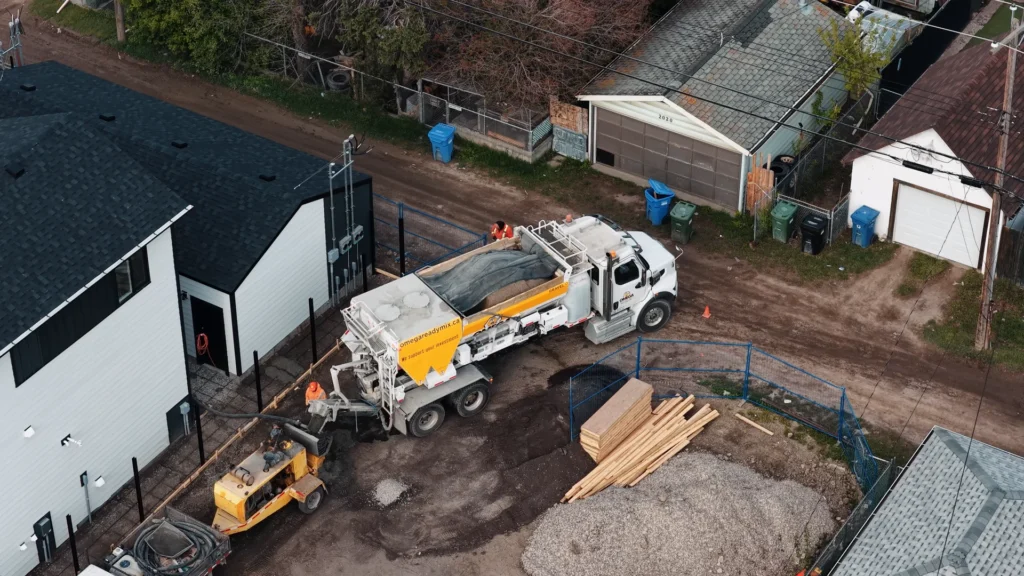
Picture a 1-yard garden-pad pour in Bridgeland in June 2026. The homeowner has roughly four hours of physical capacity to mix 45 bags. The volumetric truck arrives, sets up in ten minutes, batches the full yard continuously, and discharges the 1 yard in eight minutes of placement time. Zero cold joints. The slab cures as one monolithic pour.
Cold joints occur when one batch of concrete has begun to set before the next batch is placed against it, creating a structural discontinuity in the hardened concrete. CSA A23.1:24 §7 (the 14th edition, in force since May 2024) and ACI 304R both treat cold joints as a defect to design around, not a normal feature of a residential pour. For a 1-yard pour, 45 batches of 80-lb bagged concrete typically produce at least two to five visible cold joints — one wherever the homeowner stops to refill the wheelbarrow, swap a mixer drum, or rest his shoulders.
Cold joints are the primary failure mode in DIY bagged-concrete pours. They show up as cracks in Year 1-2 along the discontinuities and become the entry point for water, freeze-thaw cycling, and de-icer chloride attack. A 1-yard pour with three cold joints is structurally closer to four separate 0.25-yard pours bolted together by whatever rebar happens to span the joints than it is to one continuous slab. The freeze-thaw failure mode follows the joint.
A volumetric truck batched on-site delivers the full yard as a continuous pour. The mixer batches per cubic foot from cement, sand, aggregate, water and admixtures stored on the truck, and the operator can hold a constant discharge rate for the entire yard. That’s the structural advantage the bag receipt doesn’t show. The next reason is about the labor cost it also doesn’t show.
2. REASON 2 — Saturday afternoon back vs 30 minutes of supplier truck time
A homeowner-builder in Mahogany prices the 1-yard pour in March 2026. The bagged option: 45 bags at roughly $7 each is about $315, plus a half-day rental of a power mixer at $75, plus four to six hours of his own Saturday spent mixing and barrowing. The volumetric option: a quote in the $245 range, inclusive. He books the truck. He spends the Saturday on a different project. (Validate both numbers against current Calgary quotes — bagged prices and volumetric rates both moved in 2025-2026.)
A 1-yard pour requires approximately 45 80-lb bags of pre-mixed concrete or roughly 90 60-lb bags, depending on the bagged product’s water-mixing instructions. Mixing 45 bags by hand or with a small electric mixer takes four to six hours per yard for a single person working at a sustainable pace. Volumetric delivery batches the yard in 10-15 minutes on the truck and discharges in 5-10 minutes of placement time. The total truck time on site is typically under 30 minutes for a 1-yard residential pour. ACI 304R covers placement-rate expectations for residential work; the practical 1-yard math is widely consistent across Alberta dispatchers.
The labor-cost calculation usually flips in volumetric’s favor the moment the homeowner values their own Saturday at more than roughly $15 per hour after subtracting the bagged-versus-volumetric material premium. Even at minimum-wage self-valuation, a 1-yard hand-mix is typically a money-loser the homeowner only sees in hindsight.
The bagged-cost comparison that ignores labor cost is the comparison that misleads. The honest comparison includes the Saturday — and the sore back on Sunday morning. The next reason is about the mix consistency you can’t get from a bag.
Many Calgary homeowners ordering a one-yard concrete pour are building pads, garages, or backyard suites. Before finalizing your budget, read 10 Hidden Costs of the Calgary Backyard Suite Incentive Most Homeowners Don’t See, which explains the infrastructure, utility, operating, and financing costs that are often missing from early project estimates.
3. REASON 3 — Mix-design control by exposure class
A homeowner in Walden buys bagged “high-strength” concrete for a 1-yard detached-garage pad pour in summer 2026. The bag spec sheet says “4,000 psi.” It doesn’t say anything about exposure class, entrained-air content, water-to-cementitious-materials ratio, or air-content tolerance. Two years later, the pad surface spalls under the de-icer chlorides tracked in from the driveway during the December chinook cycles.
CSA A23.1:24 Table 2 specifies exposure classes — C-2 for chloride exposure, F-1 for freeze-thaw without de-icing chemicals, F-2 for freeze-thaw with de-icing chemicals, S-2 and S-3 for sulphate exposure — with specific entrained-air, w/cm and minimum-strength requirements for each. For example, F-1 exposure requires 32 MPa at 28 days, 5-8% air, w/cm ≤ 0.55. F-2 exposure requires 32 MPa at 28 days, 5-8% air, w/cm ≤ 0.45. C-2 chloride exposure tightens the spec further. Bagged concrete typically provides a single compressive-strength target without exposure-class certification or tolerance-controlled w/cm.
Volumetric mixers batch to specified exposure-class mix designs on the truck — the operator dials the cement, water, aggregate and admixture proportions to the design and produces concrete that meets the same ASTM C685/C685M-25a and CSA A23.1:24 standards as plant-batched ready-mix. “4,000 psi bagged concrete” does not equal “C-2 exposure class CSA A23.1:24-compliant.” The strength figure alone is half the spec. The freeze-thaw durability lives in the entrained-air system and the w/cm ratio, not in the headline psi.
A 1-yard pour that’s specified to a CSA exposure class survives Calgary winters. A 1-yard pour that’s specified to compressive strength alone often doesn’t — the spalling shows up in Year 2-3 and the homeowner discovers the difference between “4,000 psi” and “F-1 compliant” the hard way.
Durability isn’t the only concrete specification changing in Alberta. Developers and design teams are also adjusting mix designs to satisfy embodied-carbon requirements under LEED v5. See 6 LEED v5 Embodied-Carbon Decisions That Quietly Shift Calgary Multi-Family Concrete Specs to understand how sustainability requirements increasingly influence concrete specifications alongside strength and durability.
4. REASON 4 — Verifiable entrained air at discharge
A homeowner in Aspen Woods on a 1-yard back-step pour in October 2026. The volumetric truck batches the F-1 mix design. The operator runs a Type-B air-content meter test at discharge per CSA A23.2-4C. Result: 6.4% entrained air, comfortably inside the 5-8% target band. The homeowner takes a photo of the meter for her records. The bagged alternative would have produced concrete with no field-verified air content — just whatever the bag’s mix design assumed, modified by whatever water and mixing energy the homeowner happened to apply on the day.
CSA A23.1:24 §8.3 requires air-content verification at the point of placement for exposure classes with entrained-air requirements. Volumetric mixers can perform the air-content test on every truck. Bagged concrete provides no field-verified air content — the user mixes to the bag’s instructions and hopes the entrained-air system survived the variability in water dosing, mixing time, and ambient temperature during placement.
Bagged concrete air entrainment depends on user mixing consistency, water-to-cement ratio control, and ambient conditions during mixing. None of these are field-verified. The slab cures with whatever air content the user happened to achieve — and the homeowner never gets to find out what that number was unless he cores the slab and pays for a hardened-air analysis. (Nobody does that on a 1-yard residential pour.)
The Calgary freeze-thaw load punishes pours with under-spec entrained air. The verified-at-discharge air content from a volumetric truck is the freeze-thaw insurance the bag can’t provide. The photo of the air-meter reading is the documentation that survives the warranty conversation three winters from now. That’s reason four. The fifth is about cleanup.
5. REASON 5 — No bag-waste cleanup, no wheelbarrow cleanout, no mixer rental return
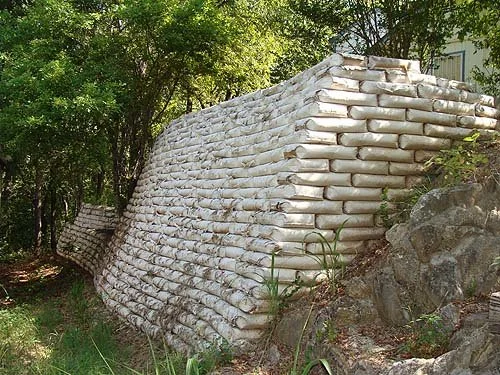
A homeowner in Killarney finishes a 1-yard bagged pour on a Sunday afternoon in 2026. He stacks 45 empty bagged-concrete bags in the driveway. The municipal garbage truck won’t take them on regular pickup — concrete-product bags fall under construction debris in most Calgary collection rules. He spends 90 minutes breaking the bags down and hauling them to the city’s construction-debris drop-off. He returns the rented power mixer with concrete-encrusted blades and pays the $40 cleaning surcharge. The volumetric alternative would have produced one wash-out container the supplier hauls away in the same truck.
Bagged concrete generates approximately 45-50 lbs of waste bag material per yard placed, plus partial bags, paper waste from kraft liners, and rinse-water residue from the wheelbarrow and mixer. Mixer rentals carry cleaning surcharges for incomplete cleanout. Volumetric trucks self-contain their wash-out and waste management as part of the dispatch — the operator washes the discharge chute into the truck’s own wash-out tank and the supplier handles disposal.
The cleanup cost is real and is routinely undercounted in the bagged-versus-volumetric comparison. For a 1-yard pour, the cleanup cost differential is typically $40-100 in volumetric’s favor once you count the disposal trip, the rental surcharge, and the Sunday-afternoon hour spent hauling empty bags. (Validate against current Calgary disposal-fee rates and rental-yard cleaning policies — both have moved in 2025-2026.)
The bagged option ends with a chore. The volumetric option ends with the supplier’s truck pulling away clean. Five reasons volumetric beats bagged on a 1-yard pour. Now the two honest reasons it sometimes doesn’t.
6. HONEST REASON IT DOESN’T 1 — Volumetric requires truck access to within ~30 feet of the discharge point
A homeowner in a heritage Inglewood property with no alley access, a 6-foot fence on one side and the house on the other. The 1-yard back-yard pour location is 70 feet from the street. The volumetric truck cannot position close enough — the chute geometry simply doesn’t reach. The supplier offers to add a pump-truck rental at $300-400 to reach the location. For a 1-yard pour, the pump-truck add-on flips the cost comparison: the bagged alternative — hauled by wheelbarrow through the side gate, in batches, accepting the cold-joint risk — is genuinely cheaper.
Volumetric mixers require truck access typically within 20-30 feet of the discharge point. Beyond that range a pump truck is required, and pump-truck rentals for short residential durations typically cost $300-500 per half-day mobilization. For a 1-yard pour, the pump-truck add-on can easily double the delivered cost and pull the volumetric option behind bagged on pure dollars.
Heritage neighborhoods with constrained access — Inglewood, Bridgeland, parts of Mission and Marda Loop, narrow downtown infill lots with no alley — are the cases where bagged concrete still wins on pure cost for a 1-yard pour. The homeowner accepts the cold-joint risk and the Saturday-afternoon back as the price of getting the pour done at all without paying for a pump truck.
Volumetric is not the universal answer. The access geometry of the specific site governs. If the truck can’t reach the discharge point and a pump truck isn’t economically justified at 1 yard, the cost case for volumetric doesn’t apply. Be honest with yourself about the driveway-and-yard layout before you call for a quote. Access is one structural exception. The other is timing.
7. HONEST REASON IT DOESN’T 2 — Same-day or after-hours weekend pours
A homeowner in Cranston discovers a broken back-step on a Sunday afternoon in July 2026 with a family reunion scheduled for the following Saturday. He needs the pour done by Wednesday. The volumetric supplier’s earliest available dispatch is Thursday — the residential book is full through midweek, which is normal in a Calgary pour season. The bagged alternative — 8 bags from the closest hardware retailer, mixed Sunday evening with a borrowed mixer — gets the step rebuilt by Monday noon.
Volumetric suppliers typically operate on 24-72 hour dispatch cycles for residential pours during peak season (April-October in Calgary). After-hours, weekend, and same-day pours require premium dispatch and may not be available at all for small residential jobs. Bagged concrete is available at building-supply retailers during all retail hours, including Sundays, and a small pour (under 0.25 yards — a step, a couple of fence-post footings, a small repair) is genuinely the use case bagged was designed for.
Same-day pours, after-hours emergency pours, and very small pours under 0.25 yards are the cases where bagged concrete wins on availability regardless of cost or quality. The cold-joint risk on a 0.1-yard back-step repair is structurally trivial. The cold-joint risk on a 1-yard slab pour is not. Match the option to the pour.
The right answer depends on the constraint. When the constraint is structural quality on a 1-yard slab pour, volumetric wins. When the constraint is access geometry, sometimes bagged wins. When the constraint is timing, sometimes bagged wins. When the constraint is cost on a 1-yard pour with normal access and a few days of lead time, volumetric usually wins on the honest accounting that includes labor and cleanup. Five reasons volumetric beats bagged. Two honest reasons it doesn’t. The right answer for the specific pour is the answer that respects all seven.
FAQ
Q1: How many bags of concrete are in 1 cubic yard? Approximately 45 80-lb bags or 90 60-lb bags, depending on the bagged product’s water-mixing instructions and yield assumptions. The yield per bag is printed on the product spec sheet; total bag count varies by 5-10% across brands. For a 1-yard Calgary pour, plan on 45 80-lb bags as the working estimate.
Q2: Will a 1-yard volumetric delivery cost less than bagged? Often yes once labor is counted, but not always. The crossover depends on site access, supplier dispatch fees, small-pour fees, and the homeowner’s valuation of their own Saturday. Bagged material at $7 per 80-lb bag × 45 = $315 looks cheaper than a $245-300 volumetric quote until you add the mixer rental, the disposal trip, and four to six hours of mixing labor. Validate both numbers against current Calgary quotes — bagged and volumetric rates both moved in 2025-2026.
Q3: Is bagged concrete CSA A23.1:24 compliant? Bagged concrete products typically meet a stated compressive-strength target (e.g., 32 MPa / 4,000 psi). They do not typically come with field-verifiable exposure-class certification (C-2, F-1, F-2) — the entrained-air content, w/cm ratio, and air-content tolerance at the point of placement are not guaranteed because they depend on the user’s mixing on the day. For Calgary residential pours requiring exposure-class compliance under CSA A23.1:24 Table 2, batched concrete (plant-delivered or volumetric) is the defensible spec.
Q4: What’s the minimum pour size a Calgary volumetric supplier will dispatch? Most Calgary volumetric suppliers will dispatch as little as 0.25-0.5 cubic yards, subject to a minimum-pour fee or short-load fee. The minimum varies by supplier and by season. Volumetric is structurally well suited to small pours because the truck batches per cubic foot rather than per drum — there’s no wasted partial-load material the way there is in a drum-mix truck.
Q5: Do bagged concrete pours have a CSA-compliant air-content system? Bagged concrete products typically include an air-entraining admixture in the dry mix. The field-achieved air content depends on user mixing consistency, water dosing, ambient temperature, and mixing time. Field air content is not verified at placement on a bagged pour. By contrast, CSA A23.1:24 §8.3 calls for air-content verification at the point of placement for exposure classes that require entrained air — a Type-B air-meter test at the volumetric truck’s discharge satisfies that requirement; a bagged pour does not.
Q6: Can volumetric mixers handle pours under 1 yard? Yes. The volumetric truck batches per yard regardless of total pour size — the on-board cement, sand, aggregate, water and admixture feed continuously and stop when the operator stops the mixer. The supplier typically charges a small-pour fee for pours below the truck’s economic minimum, and CSA A23.1:24’s 2-hour discharge clock for batched concrete still applies — but the truck itself doesn’t care whether the order is 0.5 yards or 5 yards. ACI 304.6R-09(R2019) covers volumetric mixing fundamentals.
Sources
- ASTM C685/C685M-25a — Standard Specification for Concrete Made by Volumetric Batching and Continuous Mixing — https://www.astm.org
- ASTM C94/C94M — Standard Specification for Ready-Mixed Concrete — https://www.astm.org
- ACI 304.6R-09 (Reapproved 2019) — Guide for Use of Volumetric-Measuring and Continuous-Mixing Concrete Equipment — https://www.concrete.org
- ACI 304R-00 — Guide for Measuring, Mixing, Transporting, and Placing Concrete — https://www.concrete.org
- CSA A23.1:24 / A23.2:24 — Concrete materials and methods of concrete construction / Test methods and standard practices for concrete (14th edition, in force May 2024) — https://www.csagroup.org
- City of Calgary — Standard Construction Specifications — https://www.calgary.ca/development/standards
- Concrete Alberta — Cold Weather Best Practices — https://www.concretealberta.ca
- ACI 332-20 — Code Requirements for Residential Concrete and Commentary — https://www.concrete.org
- NRMCA — Concrete in Practice series (CIP 4: Cracking; CIP 14: Finishing; CIP 17: Flowing; CIP 35: Testing) — https://www.nrmca.org
About Omega Ready Mix
Omega Ready Mix (est. 2023) is the volumetric ready-mix arm of the Omega Group, batching per-cubic-foot concrete on-site for Calgary residential, acreage, and small-commercial pours under ASTM C685/C685M-25a and CSA A23.1:24.
Not Sure Whether You Need Bagged, Volumetric, or Ready-Mix?
The right concrete isn’t determined by cubic yards alone. Access, exposure class, placement time, freeze-thaw durability, and project schedule all affect which option delivers the best value.
Whether you’re pouring a backyard pad, garage slab, fence footing, shop floor, acreage project, or small commercial slab, Omega Ready Mix can help determine whether bagged concrete, volumetric concrete, or conventional ready-mix is the most practical solution before you spend money on the wrong approach.
Request a concrete quote or talk with an Omega Ready Mix specialist today