
A Cranston multi-family architect in May 2026 has two months left to register a project under LEED v4.1. After July 1, 2026 every new registration goes through v5 — and v5 fundamentally changes the embodied-carbon math for concrete. The 6 decisions below are what shifts in the spec when v5 becomes mandatory. None of them are negotiable; all of them affect the supplier short-list.
The Canada Green Building Council (CAGBC) opened LEED v5 registration on April 28, 2026. The v4.1 sunset for new project registrations is July 1, 2026 — roughly a six-week window after the CAGBC registration date during which a Calgary architect can still register under the older system.
After that date, every new multi-family registration goes through v5, which establishes embodied-carbon disclosure and target-setting as a mandatory prerequisite for the first time.
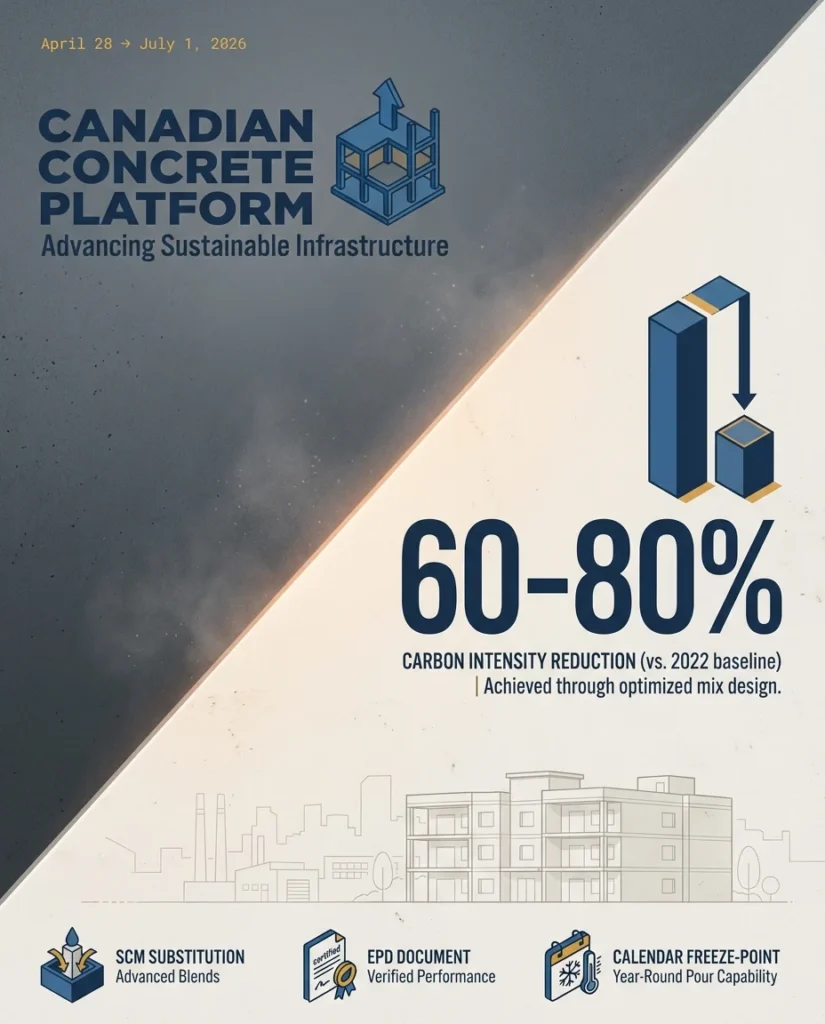
For a multi-family concrete-frame or hybrid building, concrete and steel typically account for 60-80% of the project’s A1-A3 embodied-carbon footprint. That share is not optional to address — it is the project’s largest single carbon lever, and v5 makes the lever a documentation requirement, not an optional credit.
The six decisions below are where the spec changes first. Each one moves through the supplier conversation, the mix design, the EPD package, and the construction schedule in ways that v4.1 did not require.
1. SCM substitution rate — fly ash vs slag in Calgary’s supply chain
A Mahogany multi-family architect specifies a 30% fly ash substitution on her project’s structural mix to reduce embodied carbon. Her Calgary ready-mix supplier comes back with a constraint: fly ash availability is tight.
Coal-fired power-plant closures across Western Canada since 2020 have steadily reduced the regional fly ash supply, and the major regional ready-mix producers have shifted their high-volume SCM blends toward ground granulated blast-furnace slag (GGBFS) to compensate.
The supplier proposes a 35% slag substitution instead — comparable embodied-carbon reduction, but with a slower early-strength gain curve that interacts with cold-weather scheduling.
Supplementary cementitious materials (SCMs) substitute for Portland cement and reduce the embodied carbon of concrete by displacing the most carbon-intensive ingredient. The three SCMs in routine Calgary use are fly ash (Class C and Class F per ASTM C618), ground granulated blast-furnace slag (per ASTM C989 and CSA A3001), and silica fume (per ASTM C1240).
Typical structural-mix substitution rates: 20-40% fly ash, 30-50% slag, and 5-10% silica fume, depending on the strength requirement and the cold-weather exposure of the pour. Higher substitution rates deliver larger carbon reductions but require longer curing windows and more disciplined cold-weather protection.
The supply-chain reality matters for spec accuracy. Western Canada’s fly ash supply has structurally tightened since 2020, and the regional ready-mix producers have published technical bulletins documenting the shift toward slag-blend mixes. The Concrete Association of Canada and Concrete Alberta have both flagged the supply transition in their 2025-2026 outlook briefings.
A spec that mandates a fly ash substitution rate above what the supply chain can deliver will return supplier RFI clarifications, mix-design alternates, and schedule risk — not the lower-carbon outcome the architect intended.
The embodied-carbon math: a 30% fly ash mix typically saves roughly 25-30% embodied CO2e per cubic metre versus a 100% Portland cement mix; a 35% slag mix typically saves 20-25%. On a 600-cubic-metre multi-family slab pour, that’s a 30-45 tonne CO2e reduction from one specification decision.
For LEED v5 documentation, the substitution rate is one of the highest-impact, lowest-cost decisions on the project. The cold-weather interaction (slower strength gain) matters for Calgary’s October-April pour window — discussed in decision 6.
The procurement language matters. Spec a substitution range (e.g., “30-40% SCM by mass of total cementitious”) rather than a single fixed rate. Allow either fly ash or slag (or a combination) to match the supplier’s current inventory.
Tie the substitution language to the mix-design submittal review so the supplier can propose a current-availability alternate that meets the same embodied-carbon target. The architect who specs flexibility around an embodied-carbon outcome gets the carbon reduction; the architect who specs a rigid ingredient list gets RFIs.
2. Environmental Product Declaration (EPD) documentation requirement
A Calgary spec-writer in 2026 submits the project’s concrete-mix specifications package to the LEED v5 documentation team. The submittal calls for product-specific Environmental Product Declarations covering all major structural mix designs.
The ready-mix supplier responds with industry-average EPDs covering their standard 25, 30, 35, and 40 MPa mix families — but does not yet have product-specific EPDs verified to the LEED v5 documentation standard for every mix line. The spec-writer flags a six-week documentation gap and starts a conversation with the supplier about EPD turnaround.
LEED v5 requires product-specific or facility-specific EPDs verified per ISO 14025 (Type III environmental declarations) and ISO 21930 (construction product EPD principles) for the major structural materials on a project. Concrete is one of the listed materials, alongside steel, glass, and aluminum. Industry-average EPDs (also Type III, but covering a category average rather than a specific mix and plant) provide partial documentation and contribute to baseline disclosure credits.
Product-specific EPDs — covering a named mix design produced at a named facility — are required to access the higher-credit pathways, including the embodied-carbon-reduction credits that reward measured improvement against the regional baseline.
Western Canadian concrete supplier EPD readiness varies. The Cement Association of Canada has been running an industry-wide EPD program since 2018, and most regional ready-mix producers now publish industry-average EPDs covering their major mix families.
Product-specific EPD work is in progress across the regional supply chain through 2026, but the coverage is uneven — high-volume residential and structural mixes are typically further along than specialty mixes (high-SCM blends, high-early-strength mixes, fibre-reinforced mixes). A spec-writer who calls for product-specific EPDs across every mix line on a project may discover that some specialty mixes only have industry-average EPDs available.
Why it matters for project economics. Insufficient EPD documentation can drop a project’s LEED v5 scoring tier. For multi-family projects targeting CMHC’s MLI Select climate-tier pricing — which leans on LEED-equivalent climate scoring for the highest insurance-premium reductions — the same documentation gap can affect mortgage insurance pricing in addition to the LEED certification outcome.
The EPD package is not a paperwork exercise; it’s the documentation that converts a low-carbon mix into a credentialed low-carbon mix.
The procurement language matters. Spec the EPD requirement at the mix-design submittal stage, not the construction-completion stage. Require the supplier to identify which mixes have product-specific EPDs and which have only industry-average coverage, and to commit to an EPD turnaround schedule for any specialty mixes the project requires.
Build in a six- to eight-week buffer between mix-design approval and the first pour for EPD verification. The architect who specifies EPD requirements at the right stage gets the documentation on time; the architect who specifies them late chases EPDs through occupancy.
3. Whole-building lifecycle assessment (WBLCA) tool selection
A Calgary architect runs an early WBLCA on her multi-family project in March 2026, using one of the standard tools. The model shows concrete and steel together accounting for 68% of the building’s A1-A3 embodied carbon, with structural slabs and concrete walls as the two largest single contributors.
The model identifies a 12-15% embodied-carbon reduction available if the structural slab mix shifts from a 100% Portland baseline to a 35% slag blend, and an additional 5-8% from carbon-mineralization injection. The architect re-runs the model in April after the structural engineer’s preliminary design is locked, then again at design-development with revised supplier-specific EPDs.
LEED v5 mandates an A1-A3 lifecycle stage assessment for the building’s structural and enclosure systems at a minimum. The common WBLCA tools available to Calgary practitioners are OneClick LCA (which maintains a Canadian embodied-carbon database including regional EPDs), Athena Impact Estimator for Buildings (developed by the Athena Sustainable Materials Institute and the most established North American tool). Tool selection affects both the regional-baseline reference data and the documentation pathway accepted by CAGBC.
For Calgary multi-family projects, the practical considerations are the Canadian regional dataset coverage (OneClick LCA and Athena have the deepest Canadian coverage), the workflow integration with the structural engineer’s Revit or CSI Etabs model (Tally has the tightest BIM integration; OneClick LCA imports IFC files), and the documentation export format accepted by CAGBC.
A team running a parallel embodied-carbon model alongside the structural design from schematic through construction documents has the most leverage; a team running a single model at construction-documents stage has the least.
The leverage curve is the key insight. Early-stage WBLCA (schematic design, design development) gives the design team 12-15% of embodied carbon to play with through mix substitution, structural element optimization, and material selection. Late-stage WBLCA (construction documents, construction administration) gives the team 2-3% — most of the decisions are already frozen by the time the late-stage model runs.
The Athena Sustainable Materials Institute’s multi-family benchmark studies show the same pattern across hundreds of projects: the early-stage embodied-carbon levers are the structural mix design and the structural system selection; the late-stage levers are limited to interior finishes and specification substitutions that don’t affect the structural model.
Concrete and steel typically account for 60-80% of a multi-family building’s A1-A3 embodied carbon, with the exact share depending on the construction type (wood-frame, concrete-frame, hybrid) and the structural system (flat-slab, post-tensioned, precast). For a concrete-frame multi-family building, structural slabs alone often account for 25-35% of total embodied carbon.
That single line item is where the WBLCA model points the design team, and that single line item is where the SCM-substitution and carbon-mineralization decisions in items 1 and 5 deliver the largest documented reductions.
If your project extends into October, review our guide on cold-weather concrete planning before finalizing SCM substitution rates and construction sequencing.
4. Precast vs cast-in-place embodied-carbon profile
A Calgary architect in 2026 assumes precast carries lower embodied carbon than cast-in-place because of plant-controlled mix optimization and the durability adjustment that lifecycle assessment typically credits to longer-service-life elements.
Her WBLCA shows the opposite for her specific project: precast wall panels with structural-grade mixes carry 8-12% higher A1-A3 embodied carbon than cast-in-place equivalents with high-SCM blends, primarily because the precast plant prioritizes early-release strength over SCM substitution.
The plant strips panels at 24-hour cycles to maintain production throughput, which forces a Portland-cement-rich mix design. CIP, with its longer in-place curing window, can accommodate higher SCM substitution.
She switches strategy: precast for non-load-bearing facade panels (where lower-strength mixes and architectural detailing allow more SCM substitution), cast-in-place for structural slabs (where high SCM substitution is feasible given the curing time), and a hybrid approach for parkade structural elements (where the precast plant’s durability and finish-quality control matter more than the marginal A1-A3 difference).
The technical reality: precast embodied-carbon profile depends on plant mix-design constraints. Early-release strength requirements at 24-hour stripping cycles favor Portland-cement-rich mixes; structural cast-in-place can accommodate higher SCM substitution because the curing time is measured in days, not hours.
The element-by-element trade-off varies by application. The Precast/Prestressed Concrete Institute’s sustainability resource center documents the precast-vs-CIP embodied-carbon comparison as element-specific, not categorical. Load-bearing structural slabs cast in place often win embodied-carbon comparisons; precast facade panels and parkade structural elements often win on durability-adjusted (50-100 year) lifecycle metrics.
For LEED v5 documentation, the WBLCA reports A1-A3 (cradle-to-gate) by default and may include A4-A5 (transport and construction) and B-stages (use phase) as optional disclosures. The element-by-element decision matters because the credit pathways reward measured reduction against the regional baseline, not categorical material choices.
Specifying “precast everywhere for sustainability” without a WBLCA can land the project at higher A1-A3 embodied carbon than a thoughtfully designed CIP-plus-precast hybrid; specifying “CIP everywhere for low embodied carbon” can ignore the durability and lifecycle-extension benefits that precast delivers on certain element types.
CSA A23.4-16 (R2021) governs the precast concrete production standards in Canada, including quality-management provisions and the EPD documentation expectations for precast plants. CSA A23.1:24 (the 14th edition of the concrete materials and methods standard) governs cast-in-place mix design, SCM substitution provisions, and cold-weather concreting requirements.
A spec-writer drafting the LEED v5 documentation package needs both standards in scope: precast elements documented per A23.4-16 (R2021) with the relevant EPDs; cast-in-place elements documented per A23.1:24 with the relevant mix-design and EPD package.
The procurement implications. For a Calgary multi-family project, the architect’s decision tree on precast-vs-CIP should run after the early-stage WBLCA, not before. The model shows which elements are the largest embodied-carbon contributors; the element-by-element split optimizes around those findings.
A precast supplier and a cast-in-place ready-mix supplier with overlapping technical capability — and the willingness to coordinate mix-design submittals across both — is the procurement structure that makes the element-by-element split practical to deliver.
5. Carbon-mineralization technology (CO2-injection)
A Calgary ready-mix supplier in 2026 offers CO2-injection mineralization technology on selected mix lines. The architect on a multi-family project specifies the mineralization technology on the structural slab pours and the cast-in-place wall pours.
The supplier adds approximately $4-7 per cubic metre to the mix cost; the technology provides a verified 5-8% embodied-carbon reduction per cubic metre beyond the SCM substitution alone. On a 600-cubic-metre slab pour, the cost adds $2,400 to $4,200; the embodied-carbon reduction is documented in the project’s LEED v5 EPD package and the WBLCA model.
CO2-injection mineralization is the most widely deployed carbon-mineralization technology category in the Western Canadian ready-mix supply chain, with multiple equivalent systems available through 2024-2026.
The technology injects captured CO2 into the ready-mix delivery process (typically at the truck mixer, sometimes at the batch plant), where the CO2 mineralizes within the concrete matrix as calcium carbonate.
The mineralization reaction reduces the cement content required to achieve the target strength, which is where the embodied-carbon reduction comes from. The technology is verified by ISO 14025-compliant EPDs and by independent third-party laboratory testing.
The deployment status in Calgary: CO2-injection technology is available through multiple Western Canadian ready-mix plants as of 2026, with regional supplier rollouts continuing. Documented embodied-carbon reductions per cubic metre: 5-8% when combined with SCM substitution, with the exact reduction depending on the mix design and the injection rate.
The technology adds modest cost ($4-7 per cubic metre at typical 2026 pricing — validate against current Calgary quotes) for a verified, documented carbon reduction that contributes to LEED v5 credit pathways.
For projects targeting both LEED v5 certification and CMHC’s MLI Select climate-tier scoring, carbon-mineralization is one of the few interventions that contributes to both documentation regimes. The MLI Select climate criteria reward measured embodied-carbon reductions against a regional baseline, and the verified per-cubic-metre reduction from carbon-mineralization counts toward that target.
The cost-per-tonne-of-CO2-reduced is not the cheapest carbon-reduction option on the market — SCM substitution typically delivers more carbon reduction per dollar — but the technology is documented, accessible in the Calgary supply chain today, and stacks additively with SCM substitution.
The specification language matters. Spec the technology as a performance requirement (e.g., “carbon-mineralization injection providing minimum 5% verified embodied-carbon reduction per cubic metre”) rather than a brand name, so the supplier can offer the deployed technology at their plant without an RFI.
Tie the requirement to the EPD documentation package so the carbon reduction lands in the v5 disclosure. Build the cost premium into the budget at the structural-engineering decision stage, not the construction-pricing stage — the $4-7 per cubic metre is a small structural-budget line, but a large pricing surprise if it lands late.
6. Mix-design freeze-point coordination with construction schedule
A Calgary multi-family GC receives the LEED v5-spec concrete mix design from the structural engineer in June 2026. The design documents bind the supplier to a specified SCM substitution profile (35% slag) and to carbon-mineralization injection on the structural pours.
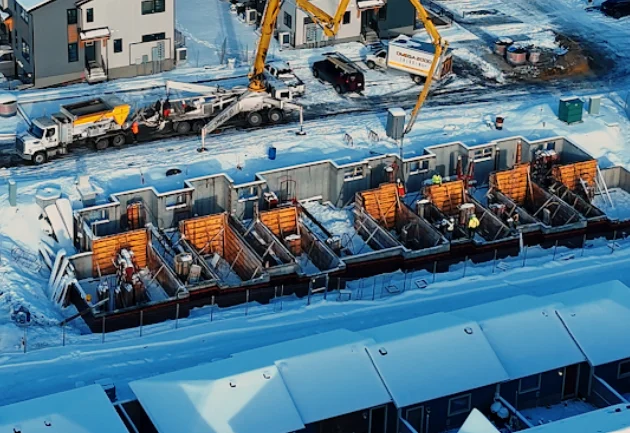
The first foundation pour is scheduled for late August, with wall pours and slab-on-grade scheduled across September and October, when ambient temperatures still support the slag-blend curing profile. The interior structural slabs are scheduled for November through January, when cold-weather provisions activate and the slag mix’s slower early-strength gain becomes a scheduling constraint.
The architect freezes the mix design for the building’s structural elements but builds in two cold-weather alternates: a reduced-SCM mix (25% slag) for post-October exterior pours where cold-weather protection costs outweigh the carbon reduction, and an enhanced-protection protocol for pours that maintain the 35% slag target through winter.
The mix-design freeze is documented in the LEED v5 submittal package; the cold-weather alternates are pre-approved by the structural engineer and pre-priced by the supplier.
Cold-weather concrete provisions per CSA A23.1:24 activate below +5°C ambient air temperature and require concrete temperature ≥10°C at placement plus maintained temperature of 10°C for a minimum of 72 hours after placement.
High-SCM slag mixes have a slower early-strength gain than 100% Portland mixes, which extends the period of cold-weather vulnerability and increases the curing-protection cost for late-season pours. Concrete Alberta’s cold-weather practice briefs document the trade-off and provide guidance on temperature-management protocols, insulation requirements, and accelerator admixture options that maintain SCM substitution targets through winter pours.
Calgary’s pour-window reality: roughly 59-65 ideal pour days per year (ambient temperatures supporting standard cold-weather protocols), concentrated May through September. Post-October pours require either temperature management (heated enclosures, hoarding, insulated forms), alternate mix design (reduced SCM substitution or accelerator admixtures), or both.
The mix-design freeze coordinated with the construction schedule is the difference between a project that lands LEED v5 documentation on time at the targeted embodied-carbon reduction and a project that chases EPD verifications and substitution-rate variances six months after occupancy.
The CSA 2-hour discharge clock — the maximum elapsed time from initial water contact to placement under CSA A23.1:24 — applies the same way for high-SCM mixes as for 100% Portland mixes, but interacts with the cold-weather curing window in ways that the GC’s pour-day planning needs to account for.
Six decisions, one certification window, one supplier conversation. The architect who walks through SCM substitution, EPD documentation, WBLCA tool selection, precast-vs-CIP element-by-element profile, carbon-mineralization technology, and mix-design freeze coordination with construction schedule — all before the July 1, 2026 v4.1 sunset — has time to land both the certification and the construction-cost target. The architect who waits has neither, and discovers the gap when the first concrete pour is six weeks away and the EPD package is still being verified.
FAQ
Q1: When is the LEED v4.1 sunset for new project registrations? LEED v4.1 sunsets for new project registrations on July 1, 2026, per the Canada Green Building Council (CAGBC) and the US Green Building Council (USGBC). LEED v5 registration through CAGBC opened April 28, 2026. Projects registered under v4.1 before July 1, 2026 may continue under that version per the published certification timeline, but every new registration after that date goes through v5.
Q2: What does LEED v5 require for embodied carbon disclosure? LEED v5 establishes embodied-carbon disclosure and target-setting as a mandatory prerequisite for the first time. Projects must complete a whole-building lifecycle assessment (WBLCA) covering A1-A3 lifecycle stages at a minimum and provide Environmental Product Declarations (EPDs) verified per ISO 14025 and ISO 21930 for major structural materials, including concrete and steel.
The Materials and Resources credit category offers up to 6 MR points, with an Optimized Product threshold of ≥20% GWP reduction plus ≥5% reduction in two other impact categories.
Q3: What share of a multi-family building’s embodied carbon comes from concrete and steel? Concrete and steel typically account for 60-80% of a multi-family building’s A1-A3 embodied carbon footprint, with structural slabs and concrete walls being the two largest single contributors.
The exact share depends on the construction type (wood-frame, concrete-frame, hybrid) and the structural system. For concrete-frame multi-family buildings, structural slabs alone often represent 25-35% of total embodied carbon.
Q4: What supplementary cementitious materials (SCMs) reduce concrete’s embodied carbon? Common SCMs include fly ash (per ASTM C618 Class C and Class F), ground granulated blast-furnace slag (per ASTM C989 and CSA A3001), and silica fume (per ASTM C1240). Typical structural-mix substitution rates: 20-40% fly ash, 30-50% slag, and 5-10% silica fume.
A 30% fly ash substitution typically saves roughly 25-30% embodied CO2e per cubic metre versus 100% Portland cement; a 35% slag substitution typically saves 20-25%. Fly ash supply has tightened across Western Canada since 2020 due to coal-plant closures, shifting the regional supply toward slag.
Q5: Does precast concrete have lower embodied carbon than cast-in-place? The comparison is element-specific, not categorical. Precast plant mixes prioritize early-release strength (typical 24-hour stripping cycles), which favors Portland-cement-rich mixes; cast-in-place can accommodate higher SCM substitution because the curing time is longer.
Load-bearing structural slabs cast in place often win A1-A3 embodied-carbon comparisons; precast facade panels and parkade structural elements often win on durability-adjusted (50-100 year) lifecycle metrics. CSA A23.4-16 (R2021) governs Canadian precast production; CSA A23.1:24 governs cast-in-place mix design and methods.
Q6: What is carbon-mineralization technology and how much does it reduce embodied carbon? Carbon-mineralization technology (CO2-injection systems) injects captured CO2 into the ready-mix delivery process, where the CO2 mineralizes within the concrete matrix and reduces the cement content required to achieve the target strength.
Documented embodied-carbon reductions per cubic metre: 5-8% when combined with SCM substitution. The technology is deployed at multiple Western Canadian ready-mix plants and adds approximately $4-7 per cubic metre to mix cost at 2026 pricing (validate against current Calgary quotes).
Sources
- CAGBC LEED v5 Registration and Transition Brief — https://www.cagbc.org/leed-v5
- USGBC LEED v5 Reference Guide — https://www.usgbc.org/leed-v5
- CSA A23.1:24 Concrete materials and methods of concrete construction (14th edition, SCM provisions) — https://www.csagroup.org
- CSA A23.4-16 (R2021) Precast concrete — materials and construction — https://www.csagroup.org
- CSA A3001 Cementitious materials for use in concrete — https://www.csagroup.org
- ASTM C618 Standard specification for coal fly ash for use in concrete — https://www.astm.org
- ASTM C989 Standard specification for slag cement for use in concrete and mortars — https://www.astm.org
- ASTM C1240 Standard specification for silica fume for use in concrete and mortar — https://www.astm.org
- ISO 14025 Environmental labels and declarations — Type III environmental declarations — https://www.iso.org
- ISO 21930 Environmental product declarations of construction products — https://www.iso.org
- Concrete Alberta SCM Supply Brief 2026 — https://www.concretealberta.ca
- Cement Association of Canada EPD Program — https://www.cement.ca
- CO2-injection mineralization technology category — vendor documentation (review the deployed system’s verified EPD documentation; do NOT name a specific vendor in published copy)
- Athena Sustainable Materials Institute WBLCA Tool and Multi-Family Benchmark Studies — https://www.athenasmi.org
- OneClick LCA Canadian Embodied Carbon Database — https://www.oneclicklca.com
- PCI Sustainability Resource Center — https://www.pci.org
- NRC IRC Embodied Carbon Reference Guide — https://nrc-publications.canada.ca
About Omega Group
Omega Group is the Calgary concrete platform that includes Omega 2000 Cribbing, Omega Ready Mix, and Omega Precast. The umbrella organization coordinates technical specification, EPD documentation, and procurement across the cast-in-place ready-mix and precast supply chain for Calgary multi-family, commercial, and industrial projects.
Planning a LEED v5 Project?
Embodied carbon is now part of the specification—not just the sustainability report.
Omega Group works with architects, structural engineers, and developers to coordinate:
- SCM mix strategies for LEED v5
- Product-specific and facility-specific EPD documentation
- Cast-in-place and precast procurement planning
- Mix-design reviews before tender
- Cold-weather concrete planning for Calgary projects
- Coordination between structural, ready-mix, and precast suppliers
Talk with our Omega Ready Mix team before your concrete specification is finalized. Early coordination typically creates more flexibility than changing mix designs after tender.
Request a LEED v5 concrete planning consultation!