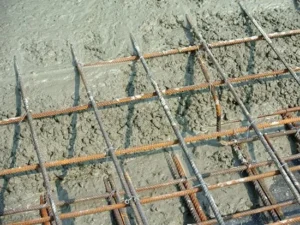

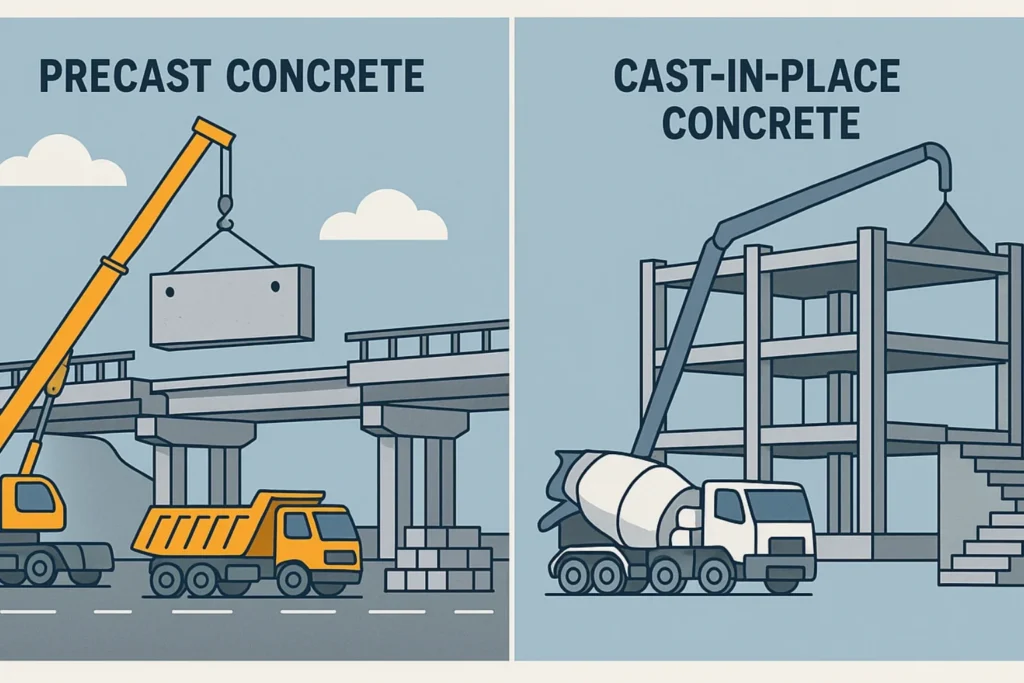
On a Saturday in late August 2025, a homeowner in Auburn Bay watched a 4-cubic-yard ready mix truck back into her driveway. The contractor signed the delivery slip, folded it twice, and put it in his back pocket. She never asked to see it. By March 2026 the slab had bloomed white. The replacement quote: $11,800.
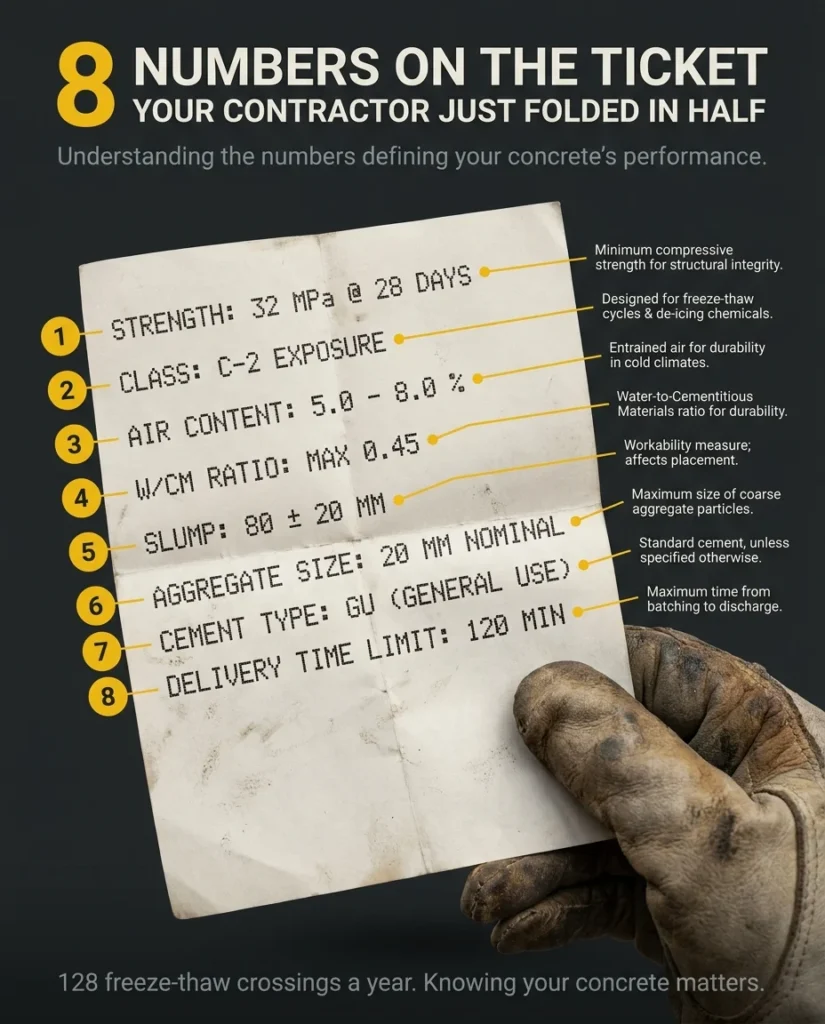
Somewhere on that folded ticket were 8 numbers that would have predicted the failure within 30 seconds of reading them. Strength class. Air content. Water-to-cement ratio. Time of batching. Exposure class. Admixtures. Aggregate size. Source plant. Each one is a binary pass/fail against CSA A23.1:24 — the standard the City of Calgary inspector uses on commercial pours and that every residential driveway should be meeting too.
This article decodes that ticket, line by line, written for the homeowner who’s about to sign a quote — not the contractor who’s about to pour it.
1. Strength class (the 32 MPa @ 28 days lie nobody catches)
A Mahogany homeowner accepts a quote that lists “32 MPa concrete” in the description column. She assumes that’s what gets delivered. The batch ticket — the one she never sees — shows 25 MPa. The contractor ordered the cheaper mix and pocketed the $14/cubic-yard delta.
CSA A23.1:24 Table 2 requires Calgary driveways at Exposure Class C-2 to be 32 MPa minimum at 28 days. C-1 (vehicular surfaces in moderate freeze-thaw without de-icing chemicals) is 30 MPa. C-2 (vehicular surfaces with de-icing chemicals — which describes every Calgary driveway because the city salts) is 32 MPa minimum. The two strength classes look interchangeable on a quote line. They aren’t.
Concrete Alberta technical bulletins flag the 25 MPa vs 32 MPa swap as the most common residential mix-spec downgrade in the province. The cost delta to the contractor is $12 to $18 per cubic yard. The strength delta to the homeowner is roughly 28% lower compressive resistance — and a driveway that won’t pass a third-party core test if she ever has to litigate.
The contractor’s defense (“she asked for 32 but I delivered what was reasonable”) falls apart against the batch ticket. The defense only works if she never asks to see it. That’s the bet — and it’s the bet most Calgary homeowners lose.
Strength is half the strength story. The other half is what’s mixed into the cement — and that’s where most failures begin.
2. Air content (the 5-8% range that decides whether the driveway survives March)
A Springbank acreage owner is told by his contractor that “we use air-entrained concrete.” The batch ticket shows 3.5% air. The pour goes in on a 22°C September afternoon. By the second freeze-thaw cycle of November the surface is already micro-scaling.
CSA A23.1:24 requires Exposure Class C-2 concrete to contain 5 to 8% entrained air verified at discharge. Below 4%, freeze-thaw protection collapses. Above 9%, compressive strength drops by 5 to 7% per percentage point of excess air. The 5-8% window isn’t a recommendation — it’s a CSA pass/fail.
Concrete pavement is approximately ten times more damaged by combined freeze-thaw plus de-icing chemicals than freeze-thaw alone. Air-entrained concrete with an optimized void matrix can run 40 to 80 years in a Calgary climate. Non-air-entrained concrete in the same climate runs 15 years or less.
The City of Calgary Climate Hazards Report (30-year average) records 128 temperature crossings of 0°C per year. Methodology note: that figure counts every individual crossing of the freezing point. The more conservative 90-110 cycles per year used by some infrastructure sources counts full sub-zero/above-zero cycles. Either way, Calgary driveways take more freeze-thaw work per year than nearly any major North American city — which is exactly why the 5-8% air spec exists, and exactly why a 3.5% reading is a slow-motion failure.
Air content also doesn’t survive what comes next on the ticket — water added by the driver after the truck arrives on site.
3. Water-to-cement ratio (the 0.45 line that the driver crosses to make the pour “easier”)
A McKenzie Towne pour day. The truck arrives. The concrete looks stiff. The contractor asks the driver to “add a bit of water.” The driver adds 30 litres. The slump goes from 60mm to 110mm. The pour is easier. The w/cm goes from 0.42 to 0.51. The homeowner watches and assumes this is normal.
CSA A23.1:24 caps the water-to-cement ratio at 0.45 for Exposure Class C-2. Every 0.01 over 0.45 reduces durability measurably. At 0.50, the entrained-air void system is partially destroyed. At 0.55, the concrete is no longer C-2 compliant regardless of what the printed ticket says.
ASTM C94 §12.7 is the universal industry reference on water addition: water added at the site by the driver invalidates the original mix design unless the contractor re-tests slump AND the addition is documented on the ticket. In Calgary, almost no residential pour documents this. The homeowner sees the water go in, doesn’t know what it means, and signs nothing.
A driveway poured at w/cm 0.51 instead of 0.42 has roughly half the freeze-thaw durability of the mix she paid for — and she has no way to prove what happened because the printed ticket still says 0.45. The chemistry is permanent the moment the water hits the drum. The paperwork doesn’t catch up.
This is where the supplier model starts to matter. The next line item explains why.
4. Mix time / time of batching (the 2-hour CSA clock most homeowners never knew existed)
An Aspen Woods homeowner books a 7 AM pour. The truck arrives at 9:15 AM — held up by a wet-pad delay on a job in Bridgeland. The concrete is now 2 hours and 8 minutes from batching. By the time it’s discharged it’s pushing 2:25. The homeowner doesn’t know there’s a clock at all.
CSA A23.1:24 mandates a maximum 2-hour (120-minute) discharge window from batching to completion of discharge — OR 300 revolutions of the drum, whichever comes first. The old US ASTM C94 90-minute clock was dropped from that standard in 2021. But US-sourced content still cites the 90-minute figure, and some Calgary contractors default to “we have 90 minutes” because that’s what they were trained on. The Canadian number is 120 minutes. Full stop.
Concrete Alberta’s cold-weather technical bulletins and the CSA A23.1:24 Annex C explicitly cite the 2-hour clock. Over the clock, the concrete cannot be guaranteed to meet its mix specs. The driver should either reject the load (and wait 45-60 minutes for another truck) or document the over-time discharge and accept that the contractor and supplier carry the risk.
A driveway poured 2 hours and 25 minutes from batching is using concrete the driver should have rejected. The homeowner has no way to know unless the ticket time stamp is checked at discharge. The clock starts when the cement hits the water at the plant — not when the truck arrives on site.
Volumetric ready mix changes this math entirely. A volumetric truck mixes each cubic yard on-site, on-demand, against the same CSA A23.1 specs and the same ASTM C685/C685M-25a production standard that govern plant ready mix. There is no 2-hour clock on the volumetric model because the concrete isn’t 2 hours old — it’s 90 seconds old.
5. Exposure class (the one-letter code that decides everything else)
A Cochrane Lake homeowner gets a quote that lists “F-1 mix” for her driveway. F-1 is the CSA exposure class for non-vehicular freeze-thaw surfaces — sidewalks, patios, exterior steps. Her driveway needs C-2. The contractor downgrades because F-1 concrete is cheaper. She doesn’t know the letters mean anything.
CSA A23.1:24 defines the residential exposure classes a Calgary homeowner will see on a quote:
- C-1 — vehicular surfaces, freeze-thaw, no de-icing chemicals → 30 MPa, w/cm ≤0.45, 4-7% air
- C-2 — vehicular surfaces, freeze-thaw, de-icing chemicals → 32 MPa, w/cm ≤0.45, 5-8% air
- F-1 — non-vehicular, freeze-thaw, no de-icing chemicals → 32 MPa, w/cm ≤0.55, 5-8% air
- F-2 — non-vehicular, freeze-thaw, with de-icing chemicals → 32 MPa, w/cm ≤0.45, 5-8% air
- N — no exposure (interior) → flexible spec
Calgary salts. Every Calgary driveway is C-2 by default. Some contractors quote F-1 because the homeowner won’t know the difference and the mix is $9-12 per cubic yard cheaper. An F-1 driveway under Calgary de-icing chemicals has roughly half the freeze-thaw cycle life of the C-2 spec the surface actually requires. It’s not a paperwork mistake. It’s a downgrade.
The exposure class is the one-letter code that decides everything else on the ticket. The strength class, the air content, the w/cm cap, the cement type — all of those numbers flow from the exposure class. Get the letter wrong and the rest of the ticket is wrong by definition.
This is the field the homeowner should circle on the quote before anything is signed. If the quote says “F-1” and the driveway will see road salt, the quote is already wrong.
6. Admixtures (the chemistry the homeowner never sees on the quote)
A Bearspaw acreage owner is told her driveway will include “the standard admixture package.” The batch ticket lists three: an air-entraining agent (correct), a water reducer (correct), and a calcium chloride accelerator at 2% for the cold-weather pour (correct). What the ticket doesn’t list: a high-range water reducer that was added at the plant to bring slump up to 180mm because the contractor wanted the pour to be effortless. By the time the concrete hits the formwork the slump is back to 90mm but the workability window has been chemically manipulated.
The four legal admixture categories named in CSA A23.1:24 are: air-entraining agents (AEA), water reducers (WR), set-control admixtures (accelerators and retarders), and high-range water reducers (HRWR / superplasticizers). Each must be listed by trade name and dose on the batch ticket if present. ASTM C494 governs the classification. CSA A23.1:24 §8.4 requires the declaration on every ticket.
In practice, Calgary residential tickets often list one or two admixtures and omit the rest. The homeowner has no idea that calcium chloride at 2% in a freeze-thaw climate accelerates corrosion of any embedded steel — rare in residential driveways, common in garage slabs with rebar. The homeowner has no idea that high-dose superplasticizer can mask a poorly designed mix at the moment of pour and disappear from the ticket entirely.
The admixture column is the chemistry the homeowner never sees on the quote. It’s also the column that explains why two driveways with identical strength and air specs can perform completely differently in year three. Two trucks, two recipes, two outcomes — and one of them is buried in the admixture line nobody reads.
Ask for the admixture declaration before the pour. If the contractor can’t produce it, that’s the warning sign — not the white bloom in March.
7. Aggregate size and gradation (the 20mm vs 14mm decision that determines crack pattern)
A Symons Valley homeowner is pouring a 5-inch residential driveway. The contractor orders 14mm aggregate because “it pours nicer.” That’s the correct call for a 4-inch slab. It’s the wrong call for a 5-inch exterior slab where 20mm coarse aggregate would give better aggregate interlock and lower drying shrinkage.
CSA A23.1:24 specifies nominal maximum aggregate size based on the minimum dimension of the pour: one-third of the slab thickness, one-fifth of the narrowest formwork dimension, or three-quarters of the rebar clear cover, whichever is smallest. For a 5-inch residential driveway, 20mm coarse aggregate is the typical Calgary spec. 14mm is acceptable for thinner sections or congested rebar — not for an open exterior slab where shrinkage cracking is the dominant failure mode.
Aggregate selection drives shrinkage. Concrete Alberta technical bulletins cite approximately 10-15% higher drying shrinkage in 14mm mixes versus 20mm mixes at the same w/cm. More shrinkage means more cracks at year 1 to year 2. The year-1 hairline crack pattern that homeowners attribute to “Calgary weather” is often a 14mm-aggregate decision the contractor made because it pumps and finishes faster — not because it’s the right spec for the slab.
The aggregate line on the ticket is the field where the contractor’s job-site convenience overrides the homeowner’s 20-year durability. Once it’s poured, the crack pattern is already decided. The only window to catch it is the quote.
The last line on the ticket is the one nobody reads. It’s also the one that decides whether the homeowner has any recourse at all.
8. Source plant / supplier identity (the field that decides whether you have recourse at all)
An Auburn Bay homeowner has a failed driveway in year 2. She wants to file an Alberta New Home Warranty Program (ANHWP) claim. ANHWP doesn’t cover flatwork — the 1-2-5-10 framework applies to the structural foundation under the 10-year structural component, not the driveway, patio, or sidewalks. She wants to sue the contractor. The contractor is dissolved. She wants to chase the supplier — but the batch ticket lists “Calgary Concrete” with no address, no plant ID, no phone number. There’s nothing to chase.
CSA A23.1:24 requires every batch ticket to identify the producer (name, plant location, certification number where applicable), the date, the time, the truck number, the customer, and the project address. Tickets without producer identification fail CSA reporting requirements — but Calgary has no provincial concrete-contractor licensing enforcement to catch a non-compliant ticket on a residential job.
Alberta has no provincial concrete-contractor licence. The consumer-protection trinity is the Prepaid Contractor’s Licence (verify yourself on Service Alberta), the WCB clearance letter, and the ANHWP 1-2-5-10 builder warranty — and none of them covers a missing supplier on a residential batch ticket. The homeowner who can’t identify the supplier has lost recourse before she’s even filed the claim. The contractor knew that. The unlabeled ticket was the warning sign she didn’t know how to read.
This is the case for the volumetric per-pour ticket model. On a 1 to 3 cubic-yard pour, the homeowner watches the mix design get dialed in on the truck’s control panel, sees the slump verified at discharge, and gets a printed ticket with the supplier name and plant identification visible from ten feet away. Volumetric ready mix meets the same ASTM C685/C685M-25a production standard and the same CSA A23.1:24 mix-spec standards as plant-batched concrete — the difference is transparency, not strength. Same eight fields. Different ticket. Different recourse.
FAQ
Q1: What’s on a concrete batch ticket in Calgary? A CSA A23.1:24-compliant batch ticket lists 8 spec-defining fields: strength class (MPa @ 28 days), air content (%), water-to-cement ratio, time of batching, exposure class (the CSA letter code — C-2 for a Calgary driveway), admixtures (trade name and dose), nominal maximum aggregate size, and producer/plant identification. The ticket also carries the truck number, the date, the customer name, and the project address. If any of the 8 spec fields are blank or missing, the ticket fails CSA reporting requirements.
Q2: What does C-2 mean on a concrete quote? C-2 is the CSA A23.1:24 exposure class for vehicular surfaces exposed to freeze-thaw AND de-icing chemicals. Every Calgary driveway is C-2 by default because the city salts in winter. The C-2 spec requires 32 MPa minimum at 28 days, water-to-cement ratio capped at 0.45, and 5 to 8% entrained air. If the quote says F-1 (the spec for non-vehicular sidewalks and patios) for a driveway, the quote is already wrong before the truck arrives.
Q3: What is the 2-hour rule for concrete trucks in Calgary? CSA A23.1:24 mandates a maximum 2-hour (120-minute) window from batching to complete discharge — or 300 revolutions of the drum, whichever comes first. The old US ASTM C94 90-minute clock was dropped in 2021. The Canadian number is 120 minutes. Over the clock, the concrete cannot be guaranteed to meet its mix specs, and the driver should either reject the load or document the over-time discharge on the ticket.
Q4: Can I ask my contractor to see the batch ticket? Yes — and you should. The CSA-compliant batch ticket exists in three copies: one for the driver, one for the contractor, and one available to the customer on request. If your contractor refuses to show you the ticket, or claims it’s “for the trades only,” that’s the warning sign. You’re paying for the concrete. You’re entitled to see the spec.
Q5: What is the minimum concrete strength for a Calgary driveway? The CSA A23.1:24 minimum for a Calgary driveway at Exposure Class C-2 is 32 MPa at 28 days. That’s the standard the City of Calgary inspector uses on commercial pours, and it’s the standard every residential driveway in Calgary should be meeting. 25 MPa, 28 MPa, and 30 MPa quotes for a Calgary driveway are all below CSA spec for a surface that will see road-salt exposure.
Q6: If my driveway fails in year 2, is ANHWP coverage automatic? No. The Alberta New Home Warranty Program 1-2-5-10 framework covers the structural foundation under the 10-year structural component — not flatwork. Driveways, patios, sidewalks, and other exterior flatwork are not covered under the new-home warranty. Recourse for a failed driveway depends on the contractor’s standing (verify the Prepaid Contractor’s Licence on Service Alberta), the WCB clearance letter, and the supplier identification on the batch ticket. If any of the three is missing, the recourse window is already narrower than the homeowner thinks.
Sources
- CSA A23.1:24 — Concrete materials and methods of concrete construction (14th edition). Table 2 (exposure classes), §8.4 (admixture declarations), Annex C (delivery clock). https://www.csagroup.org
- ASTM C685/C685M-25a — Standard Specification for Concrete Made by Volumetric Batching and Continuous Mixing. https://www.astm.org
- ASTM C94 — Standard Specification for Ready-Mixed Concrete, §12.7 (water addition rules). https://www.astm.org
- ASTM C494 — Standard Specification for Chemical Admixtures for Concrete. https://www.astm.org
- Concrete Alberta — Technical bulletins on cold-weather pours, exposure class, and residential spec disciplines. https://www.concretealberta.com
- City of Calgary Climate Hazards Report — 30-year average freeze-thaw cycle data. https://www.calgary.ca
- Alberta New Home Warranty Program (ANHWP) — 1-2-5-10 framework. https://anhwp.com
- Service Alberta — Prepaid Contractor’s Licence verification. https://www.alberta.ca
- WCB Alberta — clearance letter requirement. https://www.wcb.ab.ca
About Omega Ready Mix
Omega Ready Mix (est. 2023) is a Calgary-region volumetric ready mix supplier. Every pour is mixed on-site against CSA A23.1:24 and ASTM C685/C685M-25a, with a printed per-pour ticket the homeowner can read before the truck leaves.
Protect Your Next Concrete Pour Before the Truck Arrives
A driveway replacement can cost $10,000-$15,000. Asking for the batch ticket takes less than 30 seconds.
Before your next residential concrete project, talk to Omega Ready Mix about CSA A23.1:24-compliant volumetric concrete, on-site mixing, and transparent per-pour batch tickets that show exactly what is going into your concrete.
Get a quote today and see your mix design before the truck leaves your property.