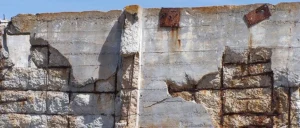

Every spring we get the same call. A homeowner in Auburn Bay or Lake Bonavista or Crestmont stands on a patio that was beautiful in October — slate stamp, charcoal release, a warm earth-tone integral colour, a glossy sealer — and looks at a surface that, in May, has white blooms across the colour field, sealer peeling like sunburned skin, hairline cracks at the corners, and a control joint that was supposed to be invisible but is now a one-eighth-inch trench full of pine needles.
The homeowner usually starts with “the contractor messed up.” Sometimes that’s true. More often, the problem is upstream — in the mix design, the sealer choice, the timing of the sealer, the de-icing-salt habits in year one, and the simple reality that Calgary’s climate is one of the more punishing environments in North America for decorative concrete. The same patio installed in Vancouver, Toronto, or Phoenix wouldn’t look like this in May. In Calgary, it often does.
Decorative concrete — stamped patterns, integrally-coloured slabs, exposed-aggregate surfaces, broom finishes with custom borders, acid-stained inlays — is one of the most popular residential concrete categories in our service area. It’s also the category where homeowner expectations and Calgary climate reality collide most violently. So this is a write-up of the six mistakes we see most often, what’s actually causing each one, and what the right move looks like from mix-design to sealer-maintenance.
We’re going to stay out of contractor finger-pointing. Most of the contractors in Calgary doing decorative work are skilled. The system around decorative concrete — bagged colour hardeners, hardware-store sealers, US-zoned product instructions, viral video tutorials, and the general absence of Alberta-specific decorative-concrete writing — is what’s actually failing homeowners.
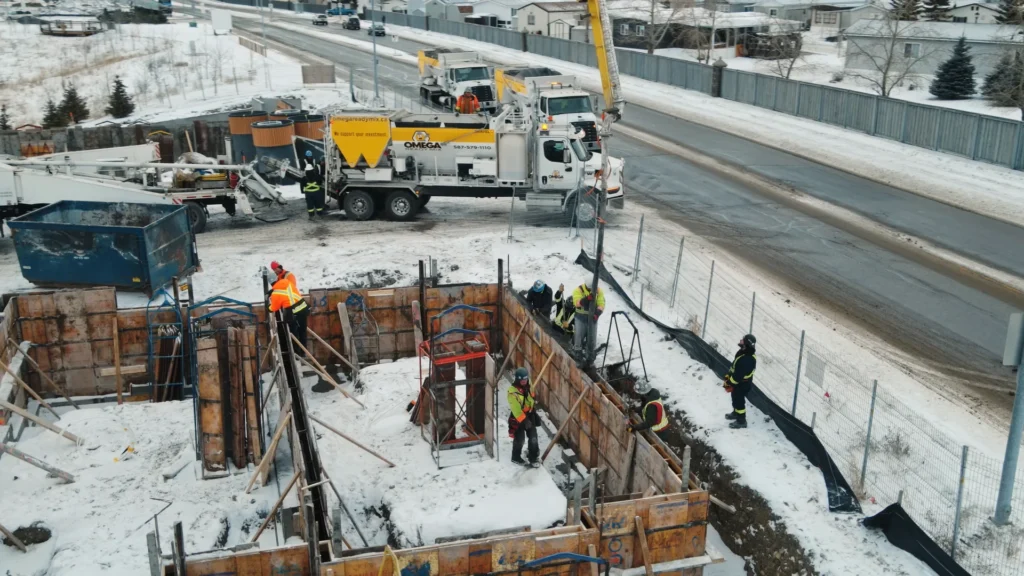
Mistake 1: Treating the slab like decoration rather than a Calgary slab first
Decorative concrete is concrete. The decorative part — stamp pattern, colour, aggregate, finish — sits on top of a slab that must perform like every other slab on your lot. In Calgary, “perform” means:
- CSA A23.1:24 Exposure Class C-2 (the class for any exterior slab subject to freeze-thaw and de-icing salts).
- 5-7% entrained air to provide pressure-relief microbubbles when water in the pore network freezes and expands.
- Type HS sulphate-resistant cement at 35 MPa HS at 56 days for foundation-adjacent work, given the sulphate content of our gumbo soils.
- A maximum 2-hour discharge limit from start of mixing to final placement, per CSA A23.1 (with a 90-minute air-content retest threshold).
- Minimum 7 days of curing at 10°C, or until the slab reaches 70% of specified 28-day strength.
The mistake homeowners and some decorative-only contractors make is starting with the decoration and asking about the slab afterward. The right sequence is the inverse. The slab spec is non-negotiable. The decoration sits on top of a slab that’s already engineered to survive Calgary. If the slab spec is compromised — under-spec’d air, over-tempered mix from sitting in a drum too long, under-cured because the homeowner walked on it Tuesday — no amount of decorative skill will save it. The surface fails because the slab fails, and the decoration goes with it.
This is part of why volumetric, ASTM C685-compliant delivery has become more popular for decorative pours. The mix is batched fresh on-site, air content is maintained through proper mechanical mixing, and the discharge window isn’t a constraint — the truck is the plant. For decorative work, where the slab’s surface integrity directly equals the customer’s perception of value, the mix arriving fresh and on-spec is doing a lot of the heavy lifting before the stampers ever touch it.
Mistake 2: Sealing too early, with the wrong sealer, in the wrong weather
Sealer failure is the single most common decorative-concrete complaint in Calgary, full stop. The forums on Beyond.ca, RedFlagDeals, and DIYChatroom are filled with first-winter-out homeowners watching their stamped slabs lift off like dead skin. The technical causes are well-documented:
(a) Sealed before the slab is ready. Concrete Network’s published guidance — echoed across multiple decorative-concrete specialists — is that new concrete should not be sealed until 30 to 60 days after install. The slab has to finish curing, has to release initial moisture from the pore network, and has to develop a stable surface chemistry before a sealer can bond to it. Sealing at day 7 or day 14 — which contractors sometimes do under homeowner pressure to “finish the project” — traps cure moisture inside the slab. That trapped moisture has to go somewhere. It goes up. Through the sealer. Lifting the sealer off the substrate.
(b) The wrong sealer for the climate. Decorative concrete in Calgary has two viable sealer families:
- Penetrating sealers (silane / siloxane) — chemistry that soaks into the concrete pore network and bonds to the cement paste, leaving no surface film. Breathable (vapor can escape). Effectively invisible (no gloss). Long-lived. Re-applied every 3-5 years.
- Film-forming sealers (acrylic, urethane, epoxy) — chemistry that builds a film on top of the slab, giving the gloss / wet-look that homeowners associate with decorative concrete. Less breathable. Susceptible to blistering, peeling, and UV breakdown. Re-applied every 1-2 years on exterior slabs in our climate.
Calgary Concrete Services and AKepoxy.ca both publish the same recommendation: for exterior, ground-level decorative work in Calgary, penetrating sealers are the safer long-term bet. They don’t trap moisture, they don’t peel, and they survive freeze-thaw because there’s no film to fail.
The catch is that the “wet-look” gloss that sells decorative concrete to homeowners is a film-forming property. Penetrating sealers don’t deliver it. So contractors and homeowners default to film-forming for the aesthetic — and accept the maintenance burden, knowingly or not. That’s a legitimate trade-off if it’s discussed in advance. The mistake is making the trade-off by accident.
(c) Sealed in the wrong weather window. Sealers applied below 10°C or with rain in the 24-hour forecast fail at adhesion. In Calgary, where the spring temperature swing can run 25°C in a day and the May forecast routinely includes rain, the sealing window matters enormously. The right move is to schedule the sealer application on a stable-weather morning, with overnight lows above 5°C and daytime highs in the 12-22°C range. Septembers are often better windows than Mays.
For Calgary homeowners with a sealer that’s already lifted: the answer is not to apply more sealer on top of failing sealer. As the local Calgary sealer specialists put it bluntly — new sealer over peeling old sealer just fails at the same rate. The lifted material has to be mechanically stripped first, the substrate has to be cleaned, and the system has to be rebuilt from the slab up. That’s a project, not a touch-up.
Mistake 3: Believing the colour will “fade” — when it’s actually the sealer breaking down
This is the most common misconception we hear about integrally-coloured concrete, and it’s worth slowing down for.
Iron-oxide pigments — the family that almost every reputable colour supplier uses for integral concrete colour — do not fade. Solomon Colors, the colour manufacturer whose “13 do’s & don’ts for integrally coloured concrete” is something we’d put in front of every Calgary homeowner before they buy a slab, says this directly: properly specified iron-oxide pigments retain their colour indefinitely.
So when a homeowner looks at a five-year-old driveway and says “the colour faded,” what they’re almost always seeing is one or more of these four things:
- Efflorescence. White or chalky surface bloom caused by soluble salts migrating to the surface as moisture moves through the slab. Looks like the colour has lifted out. It hasn’t. The colour is still there underneath the bloom.
- Sealer breakdown. The wet-look or saturated colour homeowners remember from year one is largely a sealer effect, not a pigment effect. The pigment provides the base colour. The sealer deepens it. As the sealer wears, the colour goes “flat” — not faded. Reseal, and the year-one appearance comes back.
- Surface dirt and embedment. Tire rubber, hydrocarbon residue, dust, pine sap, organic debris. Over five years, the surface gets a thin film of life that dulls the colour underneath. Power-wash, then reseal, and the colour returns.
- Surface abrasion / loss of cream. The very top layer of concrete, the “cream,” carries most of the pigment intensity. As that cream wears off — through traffic, snow shovels, ice scrapers — the colour underneath is the same iron-oxide concentration but visually less intense because the texture has changed.
In every one of those cases, the fix isn’t “the colour faded, replace it.” The fix is maintenance — strip and re-seal the surface, and the pigment that’s been there all along comes back. Concrete Network’s published guidance: “typically a good cleaning and sealing brings back the original color even after years of neglect.”
We say this not to deflect from contractor accountability but to redirect homeowner attention to where the actual maintenance lives — in the sealer cycle, not in the pigment.
Mistake 4: Treating exposed aggregate like a low-maintenance surface
Exposed aggregate is often sold as the “set-and-forget” decorative choice for Calgary because the textured surface camouflages the surface-scaling and pitting that ruins broom-finish driveways. There’s truth to that. Damage that’s highly visible on a smooth slab is camouflaged on exposed aggregate. Calgary contractors will tell homeowners — correctly — that “frost and salt damage isn’t as evident on exposed aggregate.”
What the same conversation usually skips: exposed aggregate is still concrete, still subject to the same freeze-thaw stress, and it has its own failure modes that are harder to fix.
The two failure modes specific to exposed aggregate in our climate:
(a) Aggregate pop-outs. Individual stones lift out of the surface when freeze-thaw forces overwhelm the cement-paste bond around them. Once a pop-out occurs, the void doesn’t close. It collects water and accelerates the next pop-out. Pop-outs are common in year three to five for slabs that weren’t sealed properly.
(b) Stain absorption. The textured surface and open pores of exposed aggregate are stain magnets. Oil drips, rust from patio furniture, fallen berries, organic debris — all of it absorbs faster than a smooth-finish slab and is much harder to remove. The same Calgary contractors who sell exposed aggregate as low-maintenance often have to deliver the bad news in year two that the homeowner’s barbecue spot is now a permanent feature.
The maintenance reality for exposed aggregate in Calgary:
- Seal at 30-60 days post-install with a penetrating siloxane.
- Re-seal every 3 years minimum.
- Spot-clean stains aggressively in week one of occurrence — once the stain dries down into the porous matrix, it’s typically there permanently.
- No salt-based de-icers in year one. Sand or fine grit only.
- Plan for occasional aggregate replacement on visible pop-outs (a specialty repair, not a DIY task).
None of this is fatal to exposed aggregate as a choice. It’s a beautiful surface in our climate when maintained. It’s just not low-maintenance. The marketing claim is wrong.
Mistake 5: Skipping or filling control joints incorrectly
Calgary slabs crack. Always. Not eventually — always, at some point in their life. The question isn’t whether the slab will crack; the question is whether the crack lands where you decided it would, or where the slab decided it would.
Control joints are the contractor’s answer to “decide where the crack lands.” Saw-cut to roughly 25% of the slab depth, placed at intervals of roughly 24-30 times the slab thickness (so an 8-12 ft grid for a typical 4-5 in slab), control joints create planned lines of weakness. When the inevitable shrinkage and thermal-cycle cracking happens, the slab cracks along those lines rather than zigzagging across the surface.
Expansion joints — full-depth gaps with a compressible filler — are mostly a commercial-scale concern. Residential slabs usually don’t need them except at boundaries (where a new slab meets an existing slab, building wall, or column footing).
The decorative-concrete mistakes around joints in Calgary fall into three buckets:
(a) Skipping control joints entirely because the contractor or homeowner thinks they’ll “ruin the look” of a stamp pattern. They don’t. Good decorative contractors integrate control joints into the stamp pattern as design lines — along grout lines, between stamped tiles, or as deliberate accent grooves. The slab cracks where they cut. The cracking goes invisible.
(b) Spacing them wrong. The standard rule is that joints should be spaced at 24-30 times slab thickness in feet, and never more than 36 times. For a 4-inch slab, that’s an 8-10 ft grid. For a 5-inch slab, 10-12 ft. Bigger spacing than that, and the slab decides where to crack instead of the joints.
(c) Filling them too rigidly, or never filling them. Control joints need a flexible elastomeric filler — polyurethane sealant, typically — that can compress and expand with seasonal cycling without cracking. Rigid mortar fillers crack out in year one. Empty joints fill with dirt and water, accelerating freeze-thaw damage along the joint walls. The right filler is the one between those two extremes.
For decorative work specifically, the joint fill colour matters. A grey filler in a tobacco-brown slab is visually disruptive. Tinted polyurethane fillers are available; they should be specified at the design stage, not retrofitted.
Mistake 6: Salt in year one (and other curing-window violations)
The single most damaging thing a Calgary homeowner can do to a new decorative slab is apply salt-based de-icers in the first winter. Alberta New Home Warranty Program’s homeowner guidance is unambiguous on this: de-icing salt should never be used on concrete less than one year old. The slab is still developing its full surface strength. Salt accelerates moisture penetration, lowers the freezing temperature of water in the pore network, and increases the number of freeze-thaw cycles the concrete experiences in a winter. On an unsealed or under-sealed new slab, year-one salt is the difference between a slab that’s still beautiful in 2030 and a slab that’s spalling in 2028.
The first-winter rules for decorative concrete in Calgary:
- No rock salt. No calcium chloride. No urea-based de-icers. Sand or fine grit for traction only.
- No metal snow shovels in the first month. Plastic blade only. Metal can lift the top cream layer before it’s fully bonded.
- Sealer applied before the first freeze, on a stable-weather day, at 30-60 days post-install. If the slab was poured in late September or October, the sealer goes on in spring — protected from salt and abrasion in the meantime.
- Cure protection if the pour landed in late shoulder season — curing blankets, wet burlap, or curing compound — to protect the slab from the early temperature drops that accelerate surface dehydration. CSA A23.1 requires 7 days at 10°C minimum; Calgary’s October weather often won’t deliver that without protection.
These rules sound restrictive. They are. They’re also the rules that separate a 25-year decorative slab from a 5-year decorative slab. The early window is when the chemistry locks in. Get it right and the slab forgives a lot of subsequent neglect. Get it wrong and the rest of the slab’s life is a slow undoing.
What the right decorative-concrete project actually looks like, end-to-end
Bringing it together:
- Spec the slab first. CSA A23.1 Class C-2, 5-7% entrained air, Type HS where soil sulphates demand it, 35 MPa HS at 56 days for foundation-adjacent work. The decoration is a finish on top of an engineered slab — the slab spec is non-negotiable.
- Pour fresh, on-spec. Volumetric / ASTM C685 batching gives the contractor a fresh mix on site without the discharge-window pressure that ages drum-mix concrete on busy commercial days. For decorative pours where surface integrity matters most, fresh-on-site is doing real work.
- Cure properly. 7 days at 10°C minimum. Curing blankets or compound if the shoulder season’s weather doesn’t support natural curing. No traffic for the first 7 days.
- Wait to seal. 30-60 days. Not earlier.
- Choose sealer with eyes open. Penetrating siloxane for long-term durability and minimum maintenance. Film-forming acrylic / urethane for wet-look gloss — accepting the 1-2 year re-application cycle.
- Apply sealer in the right weather window. Above 10°C, dry forecast for 24+ hours, ideally a stable spring or fall morning.
- Year one: no salt, no metal shovels, gentle handling. Treat the slab like it’s still chemically curing — because at the surface, it is.
- Year three: re-seal. Year six: re-seal. Maintenance is the deal.
This is the system that produces 20-30 year decorative slabs in Calgary. It’s not a secret system. It’s just rarely written down in one place, and rarely communicated to homeowners before they make the buying decision.
FAQ
Is integrally-coloured concrete worse for Calgary than stamped overlay?
Integrally-coloured concrete is generally better for Calgary than stamped overlay because the colour goes through the entire slab thickness, not just the top layer. Overlays are surface treatments — they can fail independently of the slab beneath them, and they’re particularly vulnerable to freeze-thaw delamination. Integral colour is part of the slab’s chemistry. When the surface wears, you see the same pigment underneath. The slab and the colour have the same life.
Can I use a film-forming sealer on a stamped patio in Calgary?
You can. Many homeowners do. The trade-off is the 1-2 year re-seal cycle versus the 3-5 year cycle of a penetrating sealer, and the risk of blistering / peeling if the slab gets sealed with any moisture trapped underneath. If you go film-forming, the rules tighten: 60+ days of cure before sealing, apply in dry stable weather above 10°C, and watch the slab closely in winters one and two for early peeling so you can intervene before the failure spreads.
My contractor says the slab will crack regardless of joints. Is that true?
Yes — and no. The slab will crack. Concrete is a brittle material that shrinks as it cures and moves with thermal cycles. The control-joint pattern decides whether those cracks land along the planned grid (where they’re invisible or designed-in) or land randomly across the surface. A slab without proper control joints will crack visibly. A slab with proper control joints cracks along the joints and stays visually clean. The contractor is technically right that “it will crack” — they’re misleading if they imply joints don’t matter.
What about acid staining in Calgary?
Acid-stained concrete relies on a chemical reaction between metallic salts in the stain and lime in the cured concrete. It’s a beautiful finish with subtle, mottled colour variation. The maintenance reality in Calgary is the same as for any decorative concrete: the slab needs the same spec, the same cure, and the same sealer discipline. Acid stains are typically sealed with film-forming products because the wet-look gloss is part of the aesthetic. That means the same 1-2 year re-seal cycle and the same first-winter caution.
How do I tell if my contractor is using a real CSA-spec mix?
Ask for the delivery ticket. Every load of concrete delivered to a Calgary jobsite — whether from a plant or from a volumetric truck — comes with a ticket that specifies the mix design, the air-entrainment target, the strength target, the slump, and the discharge time. If the contractor can’t produce a ticket, the slab isn’t documented to spec. For decorative work especially, where the homeowner is paying a premium for performance, the ticket is a routine part of the paperwork.
My slab is already peeling. Is it salvageable?
Probably. The starting point is figuring out whether the failure is surface-only (sealer lifting off a sound slab) or substrate (the slab itself is scaling or spalling). Surface-only failures are usually fixable with mechanical stripping, surface preparation, and a rebuild from a penetrating sealer up. Substrate failures are more involved — they sometimes require a topping system, an overlay, or in worst cases, a section replacement. A good decorative-concrete diagnostician — not a generalist — should be the first call. We’re happy to recommend specialists in your part of the city if it would help.
Should decorative concrete go through Omega Ready Mix or a decorative-only contractor?
Decorative-only contractors do the placement and finishing — the stamp work, the colour work, the sealing. The slab itself usually comes from a ready-mix supplier. The right partnership is decorative contractor + ready-mix supplier where the spec gets honored end-to-end. Our role is the supplier role: we deliver the slab the decorative contractor needs to do their best work on top of. We’re happy to recommend decorative-finishing contractors we’ve worked alongside who understand the Calgary climate the way we’ve described it here.
Final word
Decorative concrete in Calgary works. It can be stunning. The Bearspaw acreage entrance with a charcoal exposed-aggregate slab, the Aspen Woods backyard with an integrally-coloured terra-cotta patio framed in stamped slate borders, the Crestmont basement walkout with a polished and stained interior slab — these are projects that, when the system is right, last decades and look like the day they were poured.
The mistakes in this article are the mistakes that turn those projects into the springtime call we get every May. None of them are unfixable, but all of them are easier to avoid than to repair.
If you’re planning decorative work this season — patio, driveway, walkout, walkway, garage apron, acreage entrance — we’d rather have the conversation about mix design, timing, cure protection, and sealer strategy before the slab gets poured than after. The Omega Ready Mix team is reachable at [email protected] or 403-217-4888. Five trucks in the city, one boom pump, a 30-40 minute service radius across Calgary metro, and seven-day-a-week delivery along the acreage corridor (Bearspaw, Springbank, Priddis, De Winton, Bragg Creek, Rocky View and Foothills MD).
Your slab will be air-entrained. It’ll be on-spec. And in May 2031, when most of your neighbours’ patios are being repaired, yours will be the one you barely think about.
Related reading on omegareadymix.ca:
- Volumetric vs Drum-Mix Concrete: Calgary’s Field Guide — what fresh-on-site mix design does for decorative pours
- Calgary’s Only City-Based Volumetric Concrete Fleet — service radius, hours, and what mix-on-site means for residential work
- Can You Pour Concrete in Calgary Winter? CSA A23.1:24 §7 Explained — shoulder-season pour rules and cure protection
- Acreage Concrete Delivery: Bearspaw, Springbank, Priddis, De Winton, Bragg Creek — full service radius for decorative entrance work
Citations and standards referenced:
- Concrete Network — Repair Stamped Concrete Problems, Fixing Integral Color Issues, How to Clean Integrally Colored Concrete
- Solomon Colors — 13 Do’s & Don’ts for Success with Integrally Colored Concrete
- Calgary Concrete Services — Best Concrete Sealers for Calgary Climate: Penetrating vs Film-Forming
- AKepoxy — Exterior Concrete Sealing in Calgary
- Tampa Stamped Concrete — Stamped Concrete Patio Flaking & Color Problems
- Northeast Decorative Concrete — Why Is My Stamped Concrete Patio Flaking and Chipping?
- Consite — Concrete Repair in Calgary: Common Issues & Fixes
- Concrete Alberta — Residential Concrete Best Practices, Cold Weather Concrete Reminders
- Alberta New Home Warranty Program — Concrete: New Home Care & Maintenance
- CSA A23.1:24 — Concrete Materials and Methods of Concrete Construction
- ASTM C685 / C685M-17 — Standard Specification for Concrete Made by Volumetric Batching and Continuous Mixing
Planning a decorative pour this season — patio, driveway, garage apron, acreage entrance, walkout slab? The Omega Ready Mix team will walk through the mix design, the timing, and the cure-and-seal strategy with you before the pour. [email protected] or 403-217-4888. Calgary metro 24/7, acreage corridor 7 days a week.